Review – Key Features – Features & Benefits – Specifications
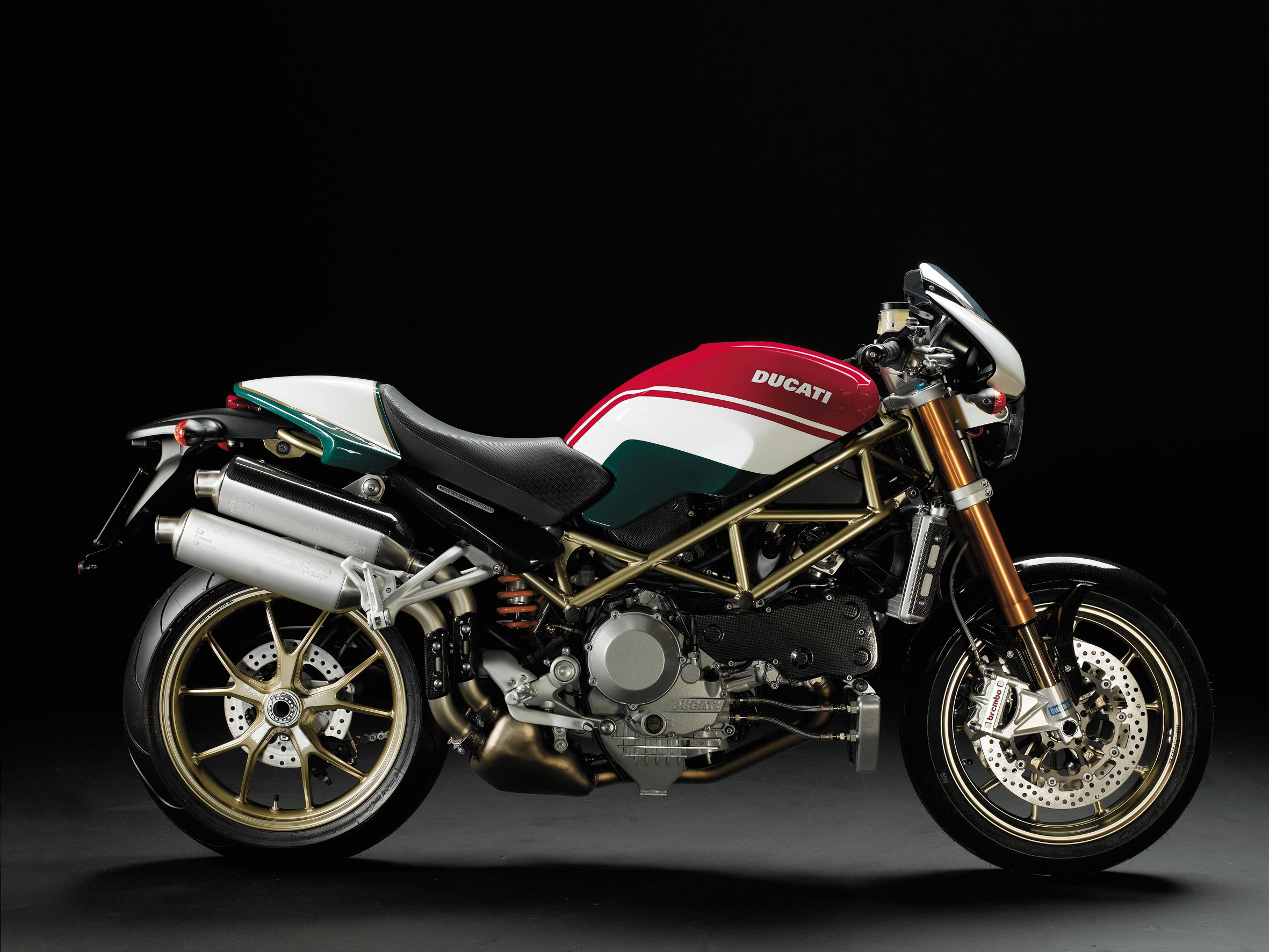
2027 Ducati Monster 100: THE FINAL EDITION SEND-OFF.
Introducing the new 2027 Ducati Monster 100…
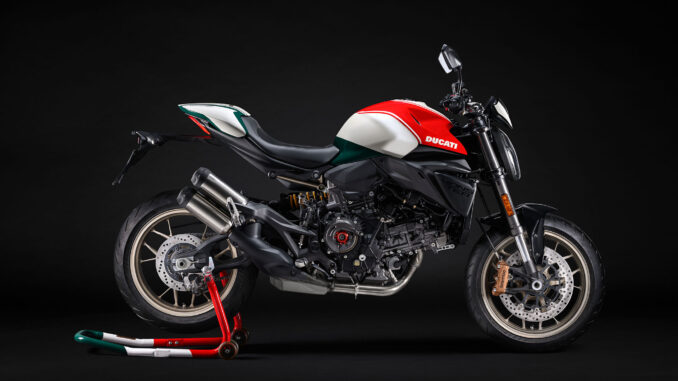
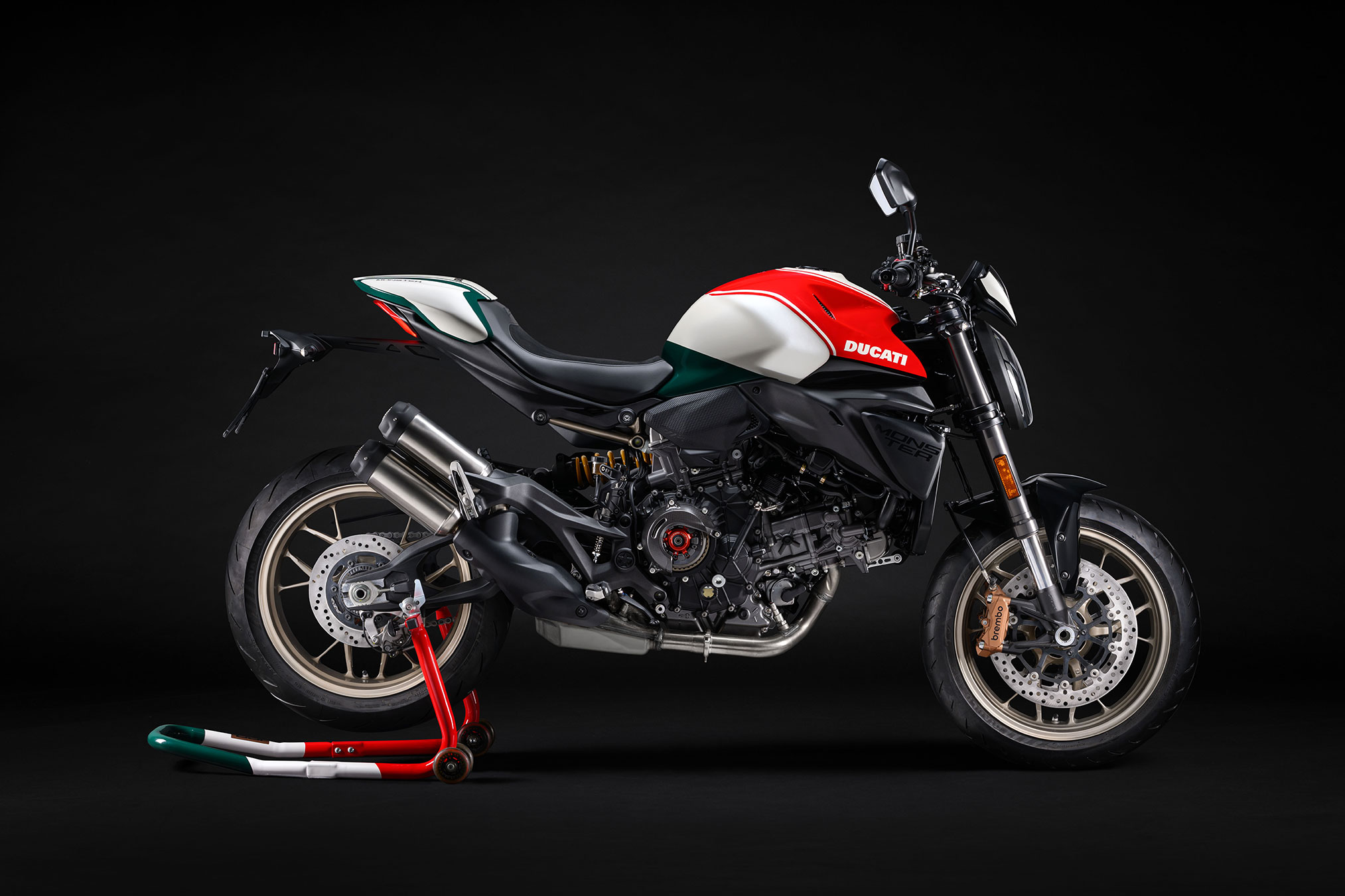
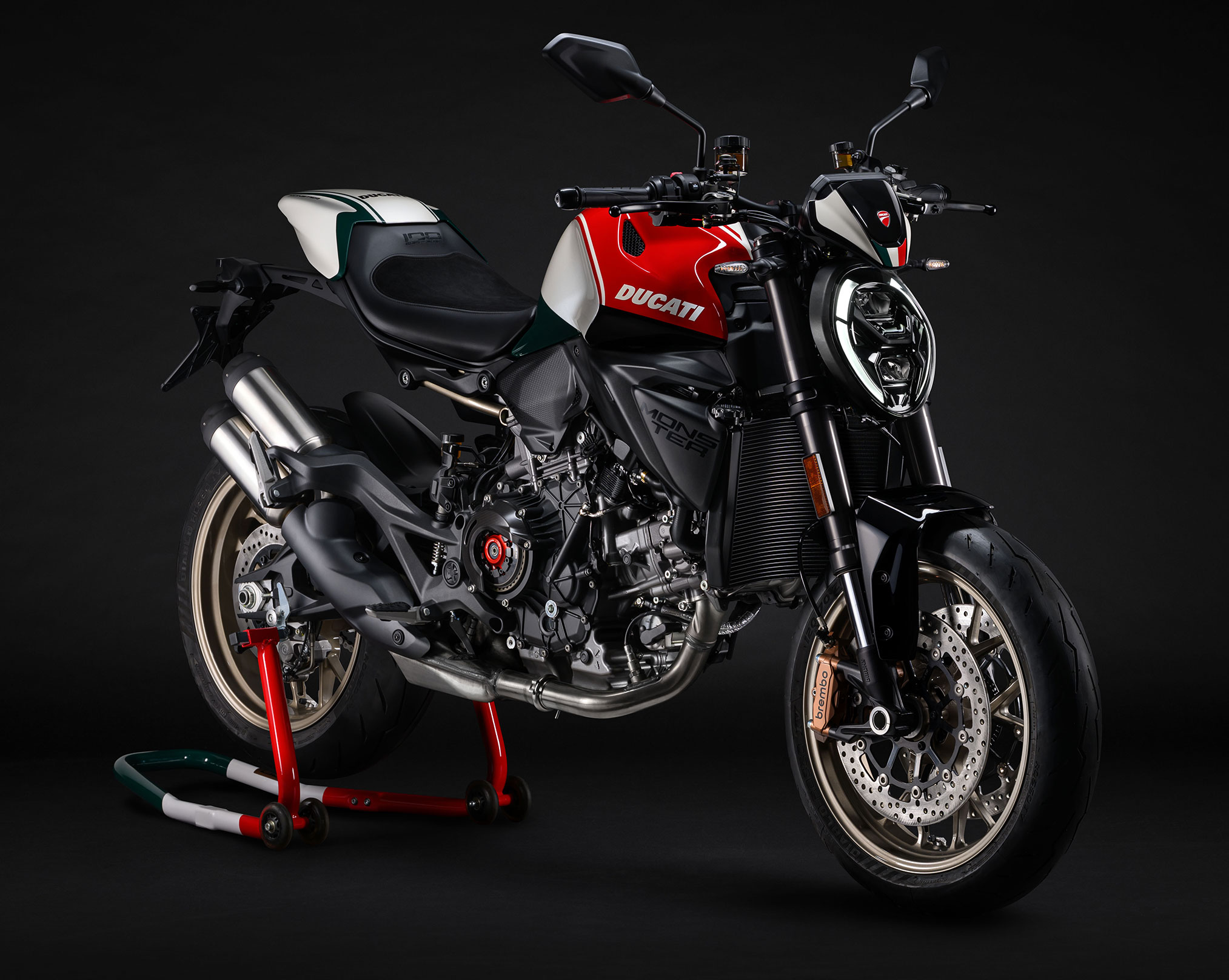
Monster 100 channels the spirit of the 2008 Monster S4Rs Tricolore, combining the essence of today’s Ducati naked bikes with a livery that marked the end of the very first, iconic generation.
Monster 100
Monster 100 represents the evolution of a Ducati icon, a bike that has been able to transcend time without losing its identity. With its essential design and immediate response, the legend that is Monster continues to be built on balance, lightness, and control. Every line reflects a pure, authentic approach to motorcycling, where simplicity defines the riding experience. This special edition interprets the original Monster spirit with sensitivity, performance and contemporary riding pleasure, entering Collezione100 as the celebration of a model that created its own language and continues to define it.
Inspiration Historic motorcycle
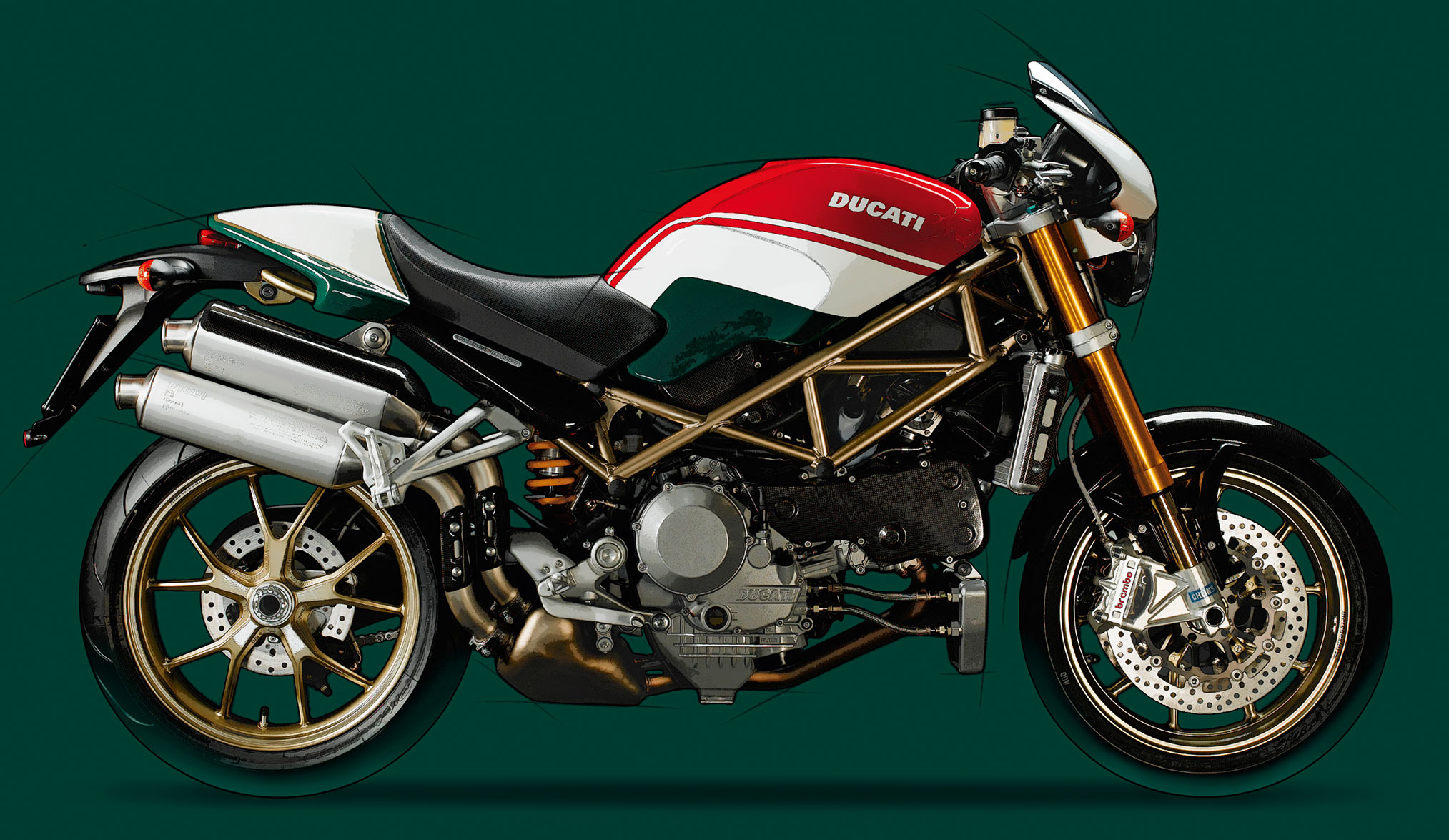
Monster S4Rs Tricolore
The Monster S4Rs Tricolore represented a sort of final edition for the first generation of Monster, which Ducati produced between 5 March 1993 and 2008. It became one of the most recognisable and iconic models, not just for the Borgo Panigale manufacturer but for the two-wheel world in general, with its round headlight and bison-back tank.The S4Rs Tricolore brought this story to its conclusion, historic identity meeting technical maturity in a bike that has become a reference for fans and is integral to Ducati heritage.
Livery
The tricolour livery of the Monster 100 faithfully reproduces the graphics used on the 2008 Monster S4Rs Tricolore. The tricolour becomes a central element, applied as a simple and immediately recognisable design motif that can highlight the bike’s clean surfaces. A solution that engages with history without nostalgia, bringing a symbol that marked the end of the first-generation Monster into the present day. The ‘Tricolore’ applied at the time to Ducati models such as the Monster S4Rs was characterised by a particular pearlescent white that enhanced the colour palette and that has been faithfully reproduced on the Monster 100.
Standout details:
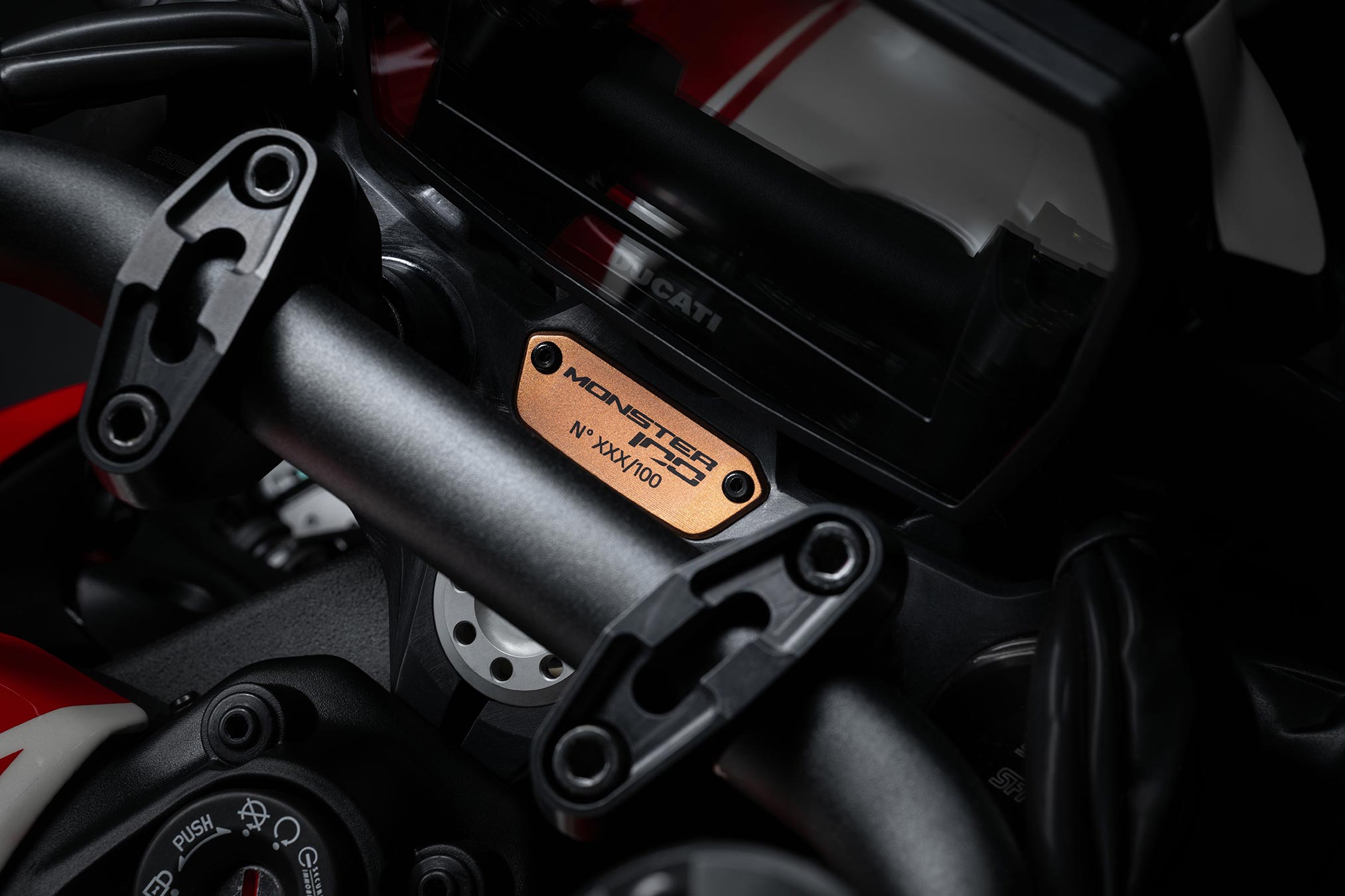
Billet aluminium steering head and brackets with a riveted plate bearing the bike name and sequential number in Centenary Bronze
01. Billet aluminium steering head and brackets with a riveted plate bearing the bike name and sequential number in Centenary Bronze
02. Front brake callipers in Centenary Bronze
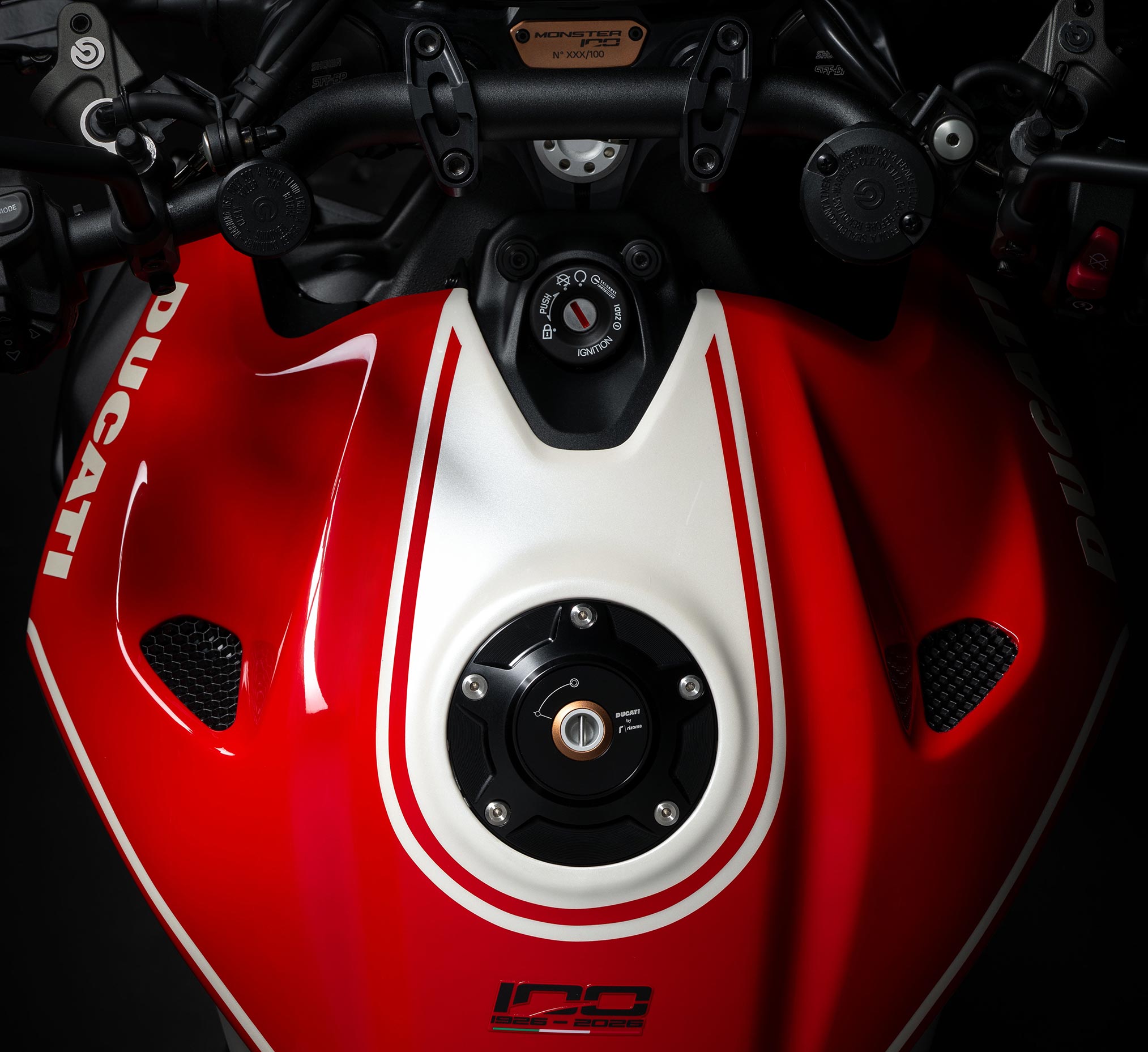
03. Centenario logo on tank
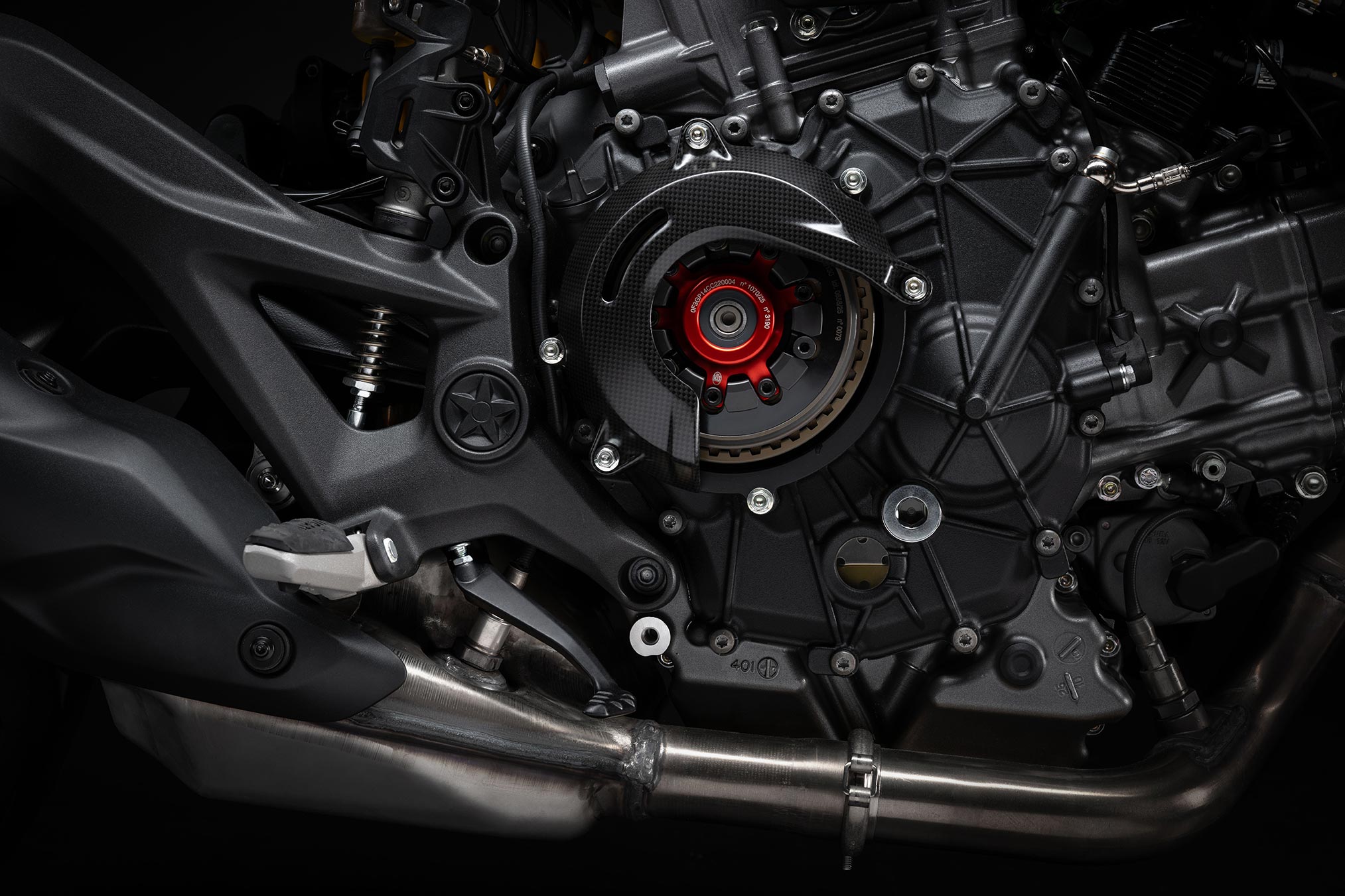
04. Dry clutch with carbon cover
A true collector’s edition
Each model is accompanied by:
- Certificate of authenticity
- Machined from billet aluminium fuel cap
- Two numbered and signed multiples of Nespolo’s artworks
- Collezione 100 motorcycle cover
- Custom rear stand
Jacket
The Monster 100 jacket flaunts urban, contemporary style, where the tricolour becomes a distinctive, identifying design motif. Produced in soft cowhide leather, it integrates shoulder and elbow protectors and fit-adjustment mechanisms, giving character and identity to everyday looks.
Helmet
The Monster 100 Tricolore helmet flaunts a clean, iconic aesthetic, where the Italian tricolour graphics reinforces Ducati identity with striking clarity. Developed around a Suomy base, it delivers a refined balance of design and functionality with a lightweight shell, efficient ventilation, and a comfortable inner lining, for everyday sports use.
Monster 100 (Monster S4Rs Tricolore – 2008)
The tricolour livery of the Monster 100 is inspired by the graphics of the 2008 Monster S4Rs Tricolore.
The Monster S4Rs Tricolore effectively represented a sort of final edition for the first generation Monster, the one Ducati produced from 5 March 1993 until 2008, becoming one of the most recognizable and iconic models not only for the Borgo Panigale manufacturer but for the motorcycle world in general.
The Monster 100 is made unique by its dry clutch, complete with a carbon fibre cover supplied with the package, and by the Alcantara seat with embroidered Ducati 100 logo, the windshield and the seat cover kit that give it a single-seater look. The Centenary Bronze plate with the name and serial number of the model is riveted to the billet steering clamps. The colour is also used on the fuel tank cap ring and brake calipers, as is the case with all the bikes in the 100 collection.
With the 2026 Model Year, based on the new V-twin engine, Ducati writes a new chapter in this unique and unrepeatable story. The fifth generation of the Monster is completely revamped, even lighter, even more authentic. Even more Monster.
The new Monster represents the fifth generation of a motorcycle that changed the history of motorcycling. When it debuted at the 1992 Cologne Motor Show, the Monster created the concept of the naked sports bike, giving rise to an entirely new segment. It instantly became a true icon.
The first Monster was born from a brilliantly simple formula: “Everything you need, nothing more.” With a chassis derived from the Superbike and the best engine for road use, the 1992 Monster successfully combined character and performance, immediately winning the hearts of countless motorcyclists. Since then, the Monster has created a global community of enthusiasts, the Monsteristi who still preserve its spirit and celebrate its history. In over thirty years of evolution, the Monster has reinvented itself without ever losing its identity. From the two-valve 900, 600, and 750 engines to the more recent Desmoquattro and Testastretta versions, each generation has brought with it technical and stylistic innovations, while keeping its original soul intact.
The new Monster marks a new era for Ducati and for its mid-displacement naked bike. It’s a completely new motorcycle, which while retaining the Monster name and spirit—the most fun engine on the road, packaged in a Superbike-derived chassis—is built on a completely new technical platform, designed around the new 890 cc 90° V-twin engine.
A motorcycle designed to deliver maximum pleasure with minimum effort on the road, focusing on lightness, easy handling, a powerful and usable engine, and sporty ergonomics without sacrificing comfort. All this confirms the strong personality that has always characterized every Monster model.
I M Legend
Monster reinvents itself. The fifth generation brings a fresh guise and a new heart: an updated design, the new V2 twin engine and cutting-edge electronic technologies.
The continuous evolution of a spirit that has never changed, a legend that has put generations of motorcyclists on the road.
Just as it did thirty years ago, Monster continues to embody the very essence of Ducati.
An icon that continues to evolve
Modernity and heritage interweave in a continuous dialogue, in the most technological Monster of all time. A bike designed down to the finest details, that retains the same spirit it had when it changed Ducati forever: simple, pure and immediately recognisable.
2027 Ducati Monster 100 Totalmotorcycle.com Key Features
Contemporary Legends
Ten models, 100 units of each worldwide. Bike liveries that have written Ducati history meet modern design and technology, for an edition that celebrates the centenary.
A collector’s edition
The exclusivity of this series goes beyond the appeal of historically inspired liveries. Each model features dedicated components developed specifically for this project, including billet‑machined steering heads and triple clamps, a dry clutch (not available on Scrambler and DesertX), seats with premium upholstery, a billet‑machined fuel cap, and brake callipers with dedicated finishes.
A legacy transformed into vision: the visual rendering of Ugo Nespolo
Where art meets speed
Ugo Nespolo, a leading figure in Italian art over the past 50 years, is entrusted with the visual interpretation of Collezione100, his creative eye transforming this commemorative project into a nuanced dialogue between motorcycling, historical identity, and figurative art.
Designed for collectors
For each bike, Ugo Nespolo created two original works: one dedicated to the historic model of inspiration, the other to its contemporary interpretation. These unique artworks will become part of the Ducati Corporate Collection.
The works give rise to numbered editions, bearing the same sequential number as the bike and signed by the artist, which will be delivered along with each Collezione100 bike, heightening their value as a collector’s item.
- Ten significant moments in Ducati’s history have inspired ten unique motorcycles, produced in a numbered series limited to just one hundred units each
- Technology, design, art: each motorcycle features unique components which, together with its livery, make it a one-of-a-kind icon, accompanied by two works of art
- Owners of each model will be able to complete the “Collezione 100” experience with a helmet and jacket in the same livery as the motorcycle
- The two DesmosediciGP bikes of the Ducati Lenovo team will race with a special livery that combines those of the Collezione 100 into a single design.
The Mugello circuit, where the Desmosedici MotoGP bikes have written numerous unforgettable pages in Ducati’s racing history, is the setting for the presentation of the Collezione 100. Ten liveries, ten numbered editions, all strictly limited to just 100 units each. True contemporary icons created to mark the centenary of the Borgo Panigale-based manufacturer.
Each model is made unique by a special specification: a livery inspired by an iconic motorcycle from Ducati’s history, Alcantara or leather seats with an embroidered Ducati logo, and premium technical details such as Centenario Bronze brake calipers. This colour is exclusive to this collection and is also used for the fuel cap crown, and for the plate bearing the model number riveted onto the steering head or the billeted triple clamps. Various mechanical components on each bike feature an exclusive colour scheme that complements the historic livery. The dry clutch, a first for V2 models*, completes the authenticity of this historic collection.
Each bike comes with a dedicated rear stand, finished in the same colours as the livery, a bike cover and a certificate of authenticity. And of course, as with all Ducati collector’s bikes, the experience of getting on the bike is made even more special by the dashboard featuring a dedicated ignition ceremony. Each owner of the Collezione 100 Collection can complete their look with a helmet and a technical jacket in a limited edition, characterized by a colour scheme that reflects that of the motorbike.**
The Collezione 100 represents yet another link between Ducati and the art world. Ugo Nespolo, a leading figure in Italian art of the late 20th century and a passionate Ducati enthusiast, has enthusiastically joined this project. Each model in the 100 Collection will be accompanied by a pair of numbered art prints bearing the same serial number as the motorcycle and signed by Nespolo himself, who has interpreted every model in the 100 Collection and the historic motorcycle that inspired its livery in his own unmistakable, colourful and dynamic style.
The result is a collection of true gems: unique, unmistakable and full of character.
The presentation took place on the legendary straight of the Tuscan circuit where, for the first time in MotoGP history, Ducati staged a vernissage. A veritable art gallery trail, where Nespolo’s works welcomed guests, accompanying them on a journey culminating in the unveiling of the ten motorcycles of the 100 Collection.
During the event, Marc Marquez and Pecco Bagnaia unveiled the Lenovo team’s bikes, featuring a special livery for the Mugello race. The design combines historic Ducati logos with dynamic geometric patterns, bringing together the ten graphics from the 100 Collection bikes on the fairing. The details celebrating the centenary and the dates 1926–2026 feature glitter, evoking the historic 750 Imola Desmo, whilst on the front fairing the modern graphics contrast with an oval number plate and vintage-style font.
Several Ducati partners have drawn inspiration to create products dedicated to the Borgo Panigale manufacturer’s centenary. The Collezione 100 has in fact inspired a series of four rucksacks created by Piquadro, unveiled during the event. Carrera, the official sponsor of the Ducati Lenovo team, has instead presented the Anniversary Edition sunglasses, produced in a numbered series limited to 500 pieces.
The next opportunity for the public to see the Collezione 100 in person will be at World Ducati Week, where they can be admired in a space reserved for all Ducatisti on 3, 4 and 5 July.
Subsequently, the ten motorcycles will embark on a journey that will take them to the Goodwood Festival of Speed, a world-class event and a must-attend for car and motorbike enthusiasts. Finally, the 100 Collection will return to Bologna, where it will be proudly displayed in various museums across the region.
- The naked model for motorcyclists seeking an iconic, charming bike that is also advanced and easy to handle.
- Compact, muscular lines inspired by the first model from 1992 adorn the lightest four-valve Monster ever.
- The new Ducati V2 engine with IVT timing guarantees brilliant performance and record maintenance intervals (28,000 mi), combining power and ease of riding.
- Sporty and intuitive: monocoque frame, Showa suspension, Brembo braking system, and a complete electronic package with Riding Mode and 6-axis IMU, for an agile, safe, and fun bike.
2027 Ducati Monster 100 Totalmotorcycle.com Features and Benefits
Design and Ergonomics
The new Monster, substantially evolved to be the lightest and most technologically advanced ever, is unmistakably a Monster from the very first glance. Starting from scratch, that is, from the ergonomics, the motorcycle’s lines have been defined while maintaining the slimness and ease of use of the previous model, combined with a sportier, more forward-leaning riding position thanks to handlebars that are both more advanced (+7 mm) and raised (+7 mm), as on the first Monsters.
The ergonomic triangle and contact surfaces with the rider have been designed to combine support, comfort, and versatility, making the new Monster enjoyable and effective for road riding while maintaining minimal physical and mental effort.
The headlight, which in motorcycle design is the true face of the motorcycle, is fully LED, with a robotic and modern look, and extremely compact to keep the front end short and “recessed” between the shoulders of the fuel tank. The latter is a crucial design element, as it has always been the most distinctive feature of the Monster. The fuel tank combines an extremely contemporary visual language with references to the most iconic models of the past, such as the air intakes at the front. These perform the dual function of cooling the tank interior and increasing the steering angle, maintaining the sculpted and muscular look that has always characterized the Monster fuel tank.
The cover on the side panels connects with the seat, which is narrower and lowered by 5 mm (815 mm total) for easier ground contact, and diverts hot air from the radiator outwards, improving thermal comfort. It features a textured surface that increases grip and retains the rider during braking, reducing effort during sporty riding. On the lower part of the cover, the Ducati shield helps transform a technical detail into a key stylistic element.
The new V-twin engine, a central element in the design of a naked bike, contributes to the minimalist image of the new Monster. Thanks to the water pump positioned on the front cylinder head, which reduces exposed tubing, the V-twin is compact and very clean in its lines, significantly improving the aesthetics in the side view.
The tail is characterized by the single seat, which, along with the fuel tank, is one of the Monster’s design icons, and by the lightweight composite subframe resting on an exposed structural trellis, another stylistic element highlighted by the different paint schemes of the two liveries.
Engine
The new Monster is powered by the new 890 cc 90° V-twin, the lightest twin-cylinder engine (54.3 kg in the version fitted to this model) ever produced by Ducati. Equipped with the IVT variable valve timing system on the hollow-stem intake valves, the new V2 represents a new chapter in the history of Ducati twin-cylinder engines, becoming the benchmark not only for its lightness, but also for its compactness, low fuel
consumption and emissions (Euro 5+ homologation), combined with a wide range of use and a fully exploitable maximum power level.
The IVT system continuously adjusts intake timing to always ensure the best possible delivery without compromising performance and usability, thus achieving high power at high revs, torque at medium and low revs, and a smooth response thanks to regular combustion. This eliminates the trade-off between low-end torque and high-end power, resulting in an engine that adapts to various conditions of use, from low-speed riding in urban traffic to sportier riding on mixed out-of-town roads.
The new engine delivers a maximum power of 111 hp (110.7 for the US version) at 9,000 rpm, with a rev limiter at 11,500 rpm. Maximum torque is 91.1 Nm at 7,250 rpm, with generous delivery even at low revs (more than 70% of maximum torque is already available at 3,000 rpm, and increasingly more than 80% between 4,000 and 10,000 rpm), ensuring a responsive ride at every throttle opening, offering excitement and usability in both urban and sporty riding.
The six-speed transmission is equipped with the second-generation Ducati Quick Shift (DQS) 2.0, which debuted on the new Panigale V4, offering a more direct shift feel, with a shorter, repeatable, and less “rubbery” travel that’s particularly appreciated during sporty riding. The clutch is an oil-bath slipper clutch with progressive hydraulic control and low load (15% less effort than the previous Monster) at the lever. The final drive ratio (16/42) has been fine-tuned to ensure optimum engine responsiveness when reopening the throttle on open roads.
For younger riders with an A2 license, a version with power limited to 35 kW is available. This version delivers maximum power of 43.5 hp at 6,250 rpm, and peak torque of 5 kgm at 5,750 rpm. Maintenance intervals include valve clearance checks every 45,000 km, reducing maintenance costs.
All information on the new Ducati V2 engine is available in the press kit.
Chassis
The chassis of the new Monster confirms the use of a monocoque structure serving both as frame and airbox, which uses the V2 engine as a structural element. This compact and rational solution allows the new Monster to reach a weight with all fluids, but without fuel, of 175 kg. This is a benchmark figure for the category, improving the already excellent weight of the previous model by 4 kg.
The wheelbase of 1,492 mm in length and a steering geometry with 23.3° rake and 92 mm trail make the Monster easy to handle, lightweight, and intuitive to lean, while maintaining stability through corners and at speed.
Monocoque Frame
The monocoque structure is cast aluminium, weighs 4 kg, and uses the new V-twin engine, to which it is attached directly to the vertical cylinder head, as a structural element. In addition to fulfilling the classic function of the frame, the monocoque also serves as an airbox: it houses the air filter, throttle bodies, and fuel circuit complete with injectors.
The rear subframe, a mixed steel/GFRP (Glass Fiber Reinforced Polymer) trellis structure, is attached to the monocoque at the top and directly to the engine at the bottom.
Suspension
The new Monster features a Showa fork with 43 mm upside-down stanchions and cast fork feet. At the rear, the Showa shock absorber is mounted laterally, attached directly to the new double-sided swingarm, offering easy access to the spring preload adjustments.
The new double-sided swingarm, attached directly to the engine, is made of aluminium alloy using low-pressure casting, which allows for a reduction in the average thickness of the structure. The heavily tapered external design recalls that of the Ducati Hollow Symmetrical Swingarm on the new Panigale V4, ensuring the same riding benefits in terms of mechanical grip, stability when exiting corners, precision in closing the line mid-corner and maintaining the trajectory through the curve.
Wheels and Tyres
The Monster is equipped with lightweight alloy wheels measuring 3.50 x 17″ at the front and 5.50 x 17″ at the rear, shod with Pirelli Diablo Rosso IV tyres in 120/70 and 180/55 sizes. The 180/55 rear tyre combines handling and an ample contact patch, favouring nimbleness in city riding and on mountain passes.
Brakes
The new Monster is equipped with a Brembo brake system that ensures high braking efficiency combined with precision and sensitivity at the brake lever, with excellent linearity between applied force and braking response.
The front calipers are M4.32 four-piston monobloc, with pads featuring a specifically selected compound to reduce initial bite and make braking more modulable, especially in city riding. The monobloc construction offers rigidity and resistance to deformation during braking, which in turn translates into improved precision and sensitivity at the brake lever. The front brake system is controlled by a Brembo PR18/21 radial master cylinder, which combines a high level of feel with class-leading stopping power.
The dual front discs are 320 mm, while the rear disc is 245 mm, with a dual-piston caliper.
Electronics
The new Monster features a latest-generation electronics package, with controls and functions derived from those of the Panigale V2. The functions are managed through a 5″ 16:9 TFT dashboard and a “petal” joystick on completely new control blocks.
To emphasize the cleanliness and elegance of the new dashboard, the physical warning lights have been removed from the external panel and moved inside the display, with the sole exception of the red LED over-rev indicator. The tachometer and gear indicator flash with a pulsating effect and turn green to indicate the moment of gear shifting, and red to signal the intervention of the rev limiter. During the running-in period, the tachometer turns orange when the recommended rpm is exceeded.
The screen features two display modes (Info Modes) called Road and Road Pro (both with automatic switching between night and day backlighting), which differ in the type of information displayed and the corresponding graphical presentation. Using the joystick on the handlebars, it is possible to switch directly between the two Info Modes while riding.
The Road display is designed to provide essential information for road riding. The circular tachometer occupies the entire right-hand side of the display, with the gear indicator in the centre. The speed and selected Riding Mode are displayed on the left. The trip computer data are located in the four corners of the display: fuel level, time, coolant temperature, and air temperature.
The Road Pro variant increases the amount of information displayed, moving the tachometer to the centre to make room for the percentage levels of power and torque delivered on the left. The parameters of the selected Riding Mode are visible on the right.
The dashboard also allows Bluetooth pairing with a smartphone and a communication system in the helmet to play music, answer calls, and listen to turn-by-turn navigation instructions, if installed.
Latest-generation electronic controls
The new Monster is equipped with modern and sophisticated electronics based on the use of a 6-axis inertial measurement platform, capable of instantly detecting the motorcycle’s roll, yaw, and pitch angles.
The Monster’s electronics package consists of:
- ABS Cornering
- Ducati Traction Control (DTC)
- Ducati Wheelie Control (DWC)
- Ducati Quick Shift (DQS) 2.0
- Engine Brake Control (EBC)
The operating parameters of each control are associated by default with the four Riding Modes (Sport, Road, Urban, Wet). Riders can customize their riding styles and restore the default parameters set by Ducati.
ABS Cornering
The Monster’s ABS system includes a “cornering” function, which extends ABS intervention even when the bike is leaning, and draws on the intervention logic and control methods of the Panigale V2. ABS Cornering can be set to three levels to fully accommodate the needs of all riders, from sporty to more relaxed riding, even in the most critical low-grip situations.
While level 3 is suitable for road or low-grip conditions, ensuring safe and stable braking at all times and constantly controlling rear wheel lift during sharp decelerations, levels 2 and 1, prioritizing braking power, are more geared towards sporty riding on high-grip surfaces.
Level 2 manages both the front and rear braking systems and keeps the cornering function active in the absence of lift-up control, allowing for more sporty braking.
Level 1, selectable even if not associated by default with any of the Riding Modes, is recommended only for expert riders. It provides racing-style ABS intervention that acts on the front wheel only. Both the “cornering” function and rear wheel lift-up prevention are disabled to maximize performance.
Ducati Traction Control (DTC)
The Ducati Traction Control strategy used on the new Monster is also derived from the Panigale V2. In addition to interfacing with the 6-axis inertial platform and adapting intervention and wheelspin to the bike’s lean angle, the software significantly improves power management out of corners thanks to the new “predictive” control strategy. By acting not only on the instantaneous value of rear spin, but also on its variation, it more quickly intercepts loss of grip and reduces wheelspin peaks, thus ensuring faster and more consistent intervention. All this translates into greater vehicle stability out of corners, even in less than optimal grip conditions, greater acceleration, and improved safety and performance in sports riding.
In addition to managing ignition advance and injection timing, DTC also intervenes on the throttle body valves when rapid intervention is not required, maintaining optimal combustion parameters and achieving smoother engine response and intervention. The control system can be set to eight different levels (six designed for dry conditions and two for wet conditions), allowing the rider to adapt the control strategy to their riding style, the environment, and grip conditions.
Ducati Wheelie Control (DWC)
The Monster is equipped with the latest version of Ducati Wheelie Control (DWC). This system, using information from the IMU 6D, controls wheelies and allows maximum acceleration performance to be achieved easily and safely. Compared to the previous Monster model, as on the Panigale and Streetfighter V2, the DWC now more accurately detects the presence and severity of wheelies and intervenes to control them with a greater level of precision, thus responding even more closely to the rider’s requests.
Ducati Quick Shift (DQS) 2.0
The new Monster uses the second-generation DQS introduced on the new Panigale V4. Compared to a traditional quickshifter, the gear lever is no longer equipped with a Hall-effect microswitch, because the shift strategy is based solely on the gear sensor located on the gear shift drum. The benefit for the rider is a more direct shift feel, with a shorter, repeatable, and less “rubbery” travel, which is particularly appreciated in track riding.
Engine Brake Control (EBC)
EBC (Engine Brake Control) was developed to help riders optimize motorcycle stability by balancing the forces acting on the rear tyre. The Monster’s EBC monitors the throttle valve position, gear selection, and crankshaft deceleration of the new V-twin during aggressive braking, and precisely adjusts the throttle opening to balance the torque forces applied to the tyre.
Riding Modes
The Riding Modes allow you to choose between four different pre-set riding styles, making the behaviour of the Monster perfectly suited to the rider, the type of track, and environmental conditions. Each Riding Mode is associated with a different control parameter setting; selecting the different Riding Modes allows you to instantly vary the engine’s character and the intervention of the electronic controls.
Sport Riding Mode
By selecting the Sport Mode, the rider can count on 111 hp of power delivery with a sporty Ride-by-Wire response to throttle opening. The electronic controls are configured to perfectly support the rider when riding on dry roads. Rear wheel lift-up prevention during braking is engaged, and the ABS Cornering function is set to offer maximum performance when cornering.
Road Riding Mode
Road Mode is recommended for use on medium-to-low-grip surfaces. This mode provides the rider with 111 hp of power delivery, with a more progressive, smoother Ride-by-Wire throttle response than Sport Mode. The default level of electronic controls is set to offer maximum safety while ensuring optimal grip and stability.
Urban Riding Mode
Urban Mode is designed for city riding on high-grip asphalt. By selecting Urban, the rider can count on the 95 hp of City Power Mode, with dynamic Ride-by-Wire throttle response. Urban mode features a default electronics setting that prioritizes vehicle stability and safety on surfaces that aren’t always optimal.
Wet Riding Mode
Wet Mode is designed for slippery surfaces, such as when it rains. With the default Low Power Mode, Ride-by-Wire response is particularly smooth, and the DTC, DWC, ABS, and EBC engine braking systems intervene even more significantly. Maximum power is limited to 95 hp/70 kW.
Of course, the rider can customize the Riding Mode parameters and later restore the default settings set by Ducati. It’s also possible to enable Level 1 ABS (recommended for more experienced riders), which intervenes only on the front wheel, without activating the cornering and lift-up control functions, for maximum braking performance.
Accessories
Ducati Performance offers a wide range of accessories to customize the new Monster. Carbon parts include the front and rear mudguards and the clutch and alternator covers, while the handlebar end weights, fuel tank and engine oil filler caps, radiator grille, rearview mirrors, and footpegs are available in billet aluminium. Also worth mentioning are the approved mufflers with titanium sleeves and carbon end caps, developed in collaboration with Termignoni, which combine a sporty design with a weight reduction of 0.2 kg.
The offering also includes brake and clutch levers, grips (heated or conventional), a USB port, Cruise Control, sport or comfort seats of varying heights, and a passenger seat bag. Other accessories will be added later, such as the TPMS tyre pressure sensor, turn-by-turn navigation system, Ducati Multimedia System, tank bags, and an Öhlins steering damper.
Unmistakable personality
The new Monster, redesigned from the ground up, combines lightness and technology with an unmistakable aesthetic that reinterprets the style of the first Monster in a modern key. Slimmer, sportier, and more compact, the new Monster captivates by reviving the stylistic features that have always distinguished the naked bike par excellence: the headlight framed by the bison-back “shoulders” of the fuel tank, the one-piece seat, and the short, lightweight tail fairing.
The new V2, modern and characterized by a highly clean aesthetic thanks to precise technical choices, is the perfect engine for the Monster. The naked bike from Borgo Panigale has always had the V-twin—a noble engine characterized by its slimness, optimal weight distribution, and reduced vibrations thanks to a perfect balance of first-order forces—as one of its technical and stylistic cornerstones.
The Ducati V2 is lightweight (5.9 kg less than the previous Testastretta Evoluzione) and high-performance, thanks to IVT (Intake Variable Timing), and is characterized by very low running costs: the 45,000 km maintenance interval for valve clearance checks is an absolute benchmark for the category.
The IVT variable timing system allows the Monster engine to combine regularity at low revs, a vigorous mid-range, and high-revving power (111 hp at 9,000 rpm, 110.7 HP for the USA version), delivering more than 80% of its maximum torque from 4,000 to 10,000 rpm. Thanks to this responsive power delivery, a traditional Monster characteristic, and comprehensive and sophisticated electronic management, the new V2 delivers its performance safely and without ever being demanding for the rider.
Sports Chassis
The new Ducati V2 serves as the stressed part of the chassis. It is based on a monocoque frame, a double-sided swingarm inspired by the Ducati Hollow Swingarm of the Panigale V4, and a rear subframe consisting of a techno-polymer element and a trellis. This technical design, combined with the engine, helps make the new Monster even lighter than the already very light previous model (4 kg less, for a total weight with an empty tank of 175 kg) and therefore nimble and easy to ride in any situation. The 43 mm upside-down fork and monoshock, both Showa, have been specifically calibrated to optimize comfort for everyday use and sportiness for mixed-road riding, confirming the dual soul of the naked Ducati. The new Monster is thus more stable and gives its rider greater confidence, while remaining nimble and enjoyable.
The Brembo braking system features dual 320 mm front discs, with M4.32 radial calipers and dedicated pads, specifically developed to offer a softer initial “attack” combined with high stopping power. This makes the Monster safe and fun for sporty riding, yet highly manageable in urban environments. The Diablo Rosso IV tyres, in 120/70 and 180/55 sizes, are Pirelli’s top-of-the-line tyres for road use, offering grip and safety.
The rider sits on a lower (815 mm, which can be reduced to 775 mm with the addition of low seats and lowered suspension) and narrower seat than the previous model, allowing for easier ground contact. The handlebars, higher and more forward, enhance the feeling of control during sporty riding while also creating a comfortable riding position for more relaxed use. The grip textured side panels support the rider when braking, while at the same time becoming a style element that celebrates the Monster’s history with the Ducati shield proudly displayed on the lower section.
Intuitive and fun, the Monster can change its soul at the touch of a button thanks to four Riding Modes specifically designed to simplify and enhance riding in any situation. Sportier riders will appreciate the engine’s punch in the Sport Riding Mode on mixed mountain roads, while also benefiting from the safety of the electronic management system which includes DTC (Ducati Traction Control), DWC (Ducati Wheelie Control), EBC (Engine Brake Control), and ABS Cornering. At the same time, less experienced riders and those who enjoy riding the Monster around town will find it easier and quicker to familiarize themselves with the naked Ducati thanks to the Road and Urban Riding Modes.
Everything is easily managed via the new petal-shaped joystick controls and the 5″ TFT display, which is already set up for the Ducati Multimedia System and turn-by-turn navigation. The dashboard is always clearly legible thanks to the dual mode (day and night) and the display based on the Road and Road Pro Info Modes, which allow the rider to concentrate on riding by optimizing visibility of the most relevant information in each context.
Accessories
The Monster is one of the Ducatis that has most stimulated the imagination of its owners when it comes to customization. To satisfy those who want to really make the Monster their own, Ducati Performance offers a wide range of accessories to enhance its aesthetics, such as carbon fibre details, billet aluminium parts, or the sporty seat with Alcantara upholstery.
Sporty riders will also appreciate the homologated silencers with titanium sleeves and carbon end caps, developed in collaboration with Termignoni, which reduce the weight (-0.2 kg) and significantly increase the Monster’s aggressiveness.
Availability and Colours
The new Monster will arrive in dealerships in February 2026, in two liveries: Ducati Red and Iceberg White, in both Monster and Monster+ versions, which features a windshield and passenger seat cover. Both are also available in a 35 kW version for riders with an A2 license.
2027 Ducati Monster 100 – Totalmotorcycle.com Specifications and Technical Details
US MSRP Price: $ See Dealer USD
Canada MSRP Price: $ See Dealer CDN
Europe/UK MSRP Price: £ See Dealer for pricing GBP (On The Road inc 20% Vat)
Displacement 890 cc (54,3 cu in)
Power 111 hp (81,6 kW) @ 9.000 rpm
Torque 91,1 Nm (9,3 kgm, 67 lb ft) @ 7.250 rpm
Wet weight no fuel 175 kg (386 lb)
Seat Height 815 mm (32,1 in)
795 mm (31,3 in) with low seat accessory
775 mm (30,5 in) with low seat accessory + low suspension kit
Fuel Tank Capacity 14 l (3,7 US gal)
*Please check with your dealer product availability
Bike specifications and equipment may vary from market to market. Please refer to your local dealer for further information.
Manufacturer Specifications and appearance are subject to change without prior notice on Total Motorcycle (TMW).