
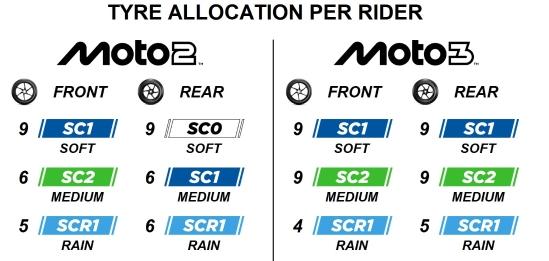
- One extra set for the longer sessions. TheAutódromo Internacional de Goiânia – Ayrton Senna, which will host the Grand Prix of Brazil, previously welcomed the Motorcycle World Championship in the late 1980s but has recently been completely resurfaced and undergone layout modifications. To allow teams and riders to familiarise themselves with the track, Friday’s FP1 and FP2 sessions for Moto2™ and Moto3™ will each be extended by 10 minutes, giving riders a total of 20 additional minutes. For this reason, riders will have one extra set of tyres available, for a total of 19 tyres – 9 front and 10 rear – usable over the weekend, compared to the standard allocation of 17 (8 front and 9 rear).
· More units for each solution. With the possibility of using an extra tyre set, Pirelli is providing riders with a larger quantity of tyres than at other GPs. Specifically, each Moto2™ rider is allocated 9 units of the soft solutions (SC1 front and SC0 rear) and 6 units of the medium ones (SC2 front and SC1 rear). As for Moto3™, each rider has 9 units for each of the two front solutions and two rear solutions. At this time of year in Goiânia, the likelihood of rain is quite high, in which case riders may use the DIABLO™ Rain wet tyres.
· A bit of history. The Motorcycle World Championship returns to Brazil after a 22‑year absence. The South American nation has hosted 13 Grand Prix events in the past, the first in 1987 at the Goiânia circuit, where the event continued for the next two years before moving for a single edition to Interlagos in 1992. The third and last circuit to host the World Championship was Rio de Janeiro’s Autódromo de Jacarepaguá, where nine GPs were held from 1995 to 2004, with the only exception of 1998.
A new circuit we tackle with standard tyres
“Although it hosted the Motorcycle Grand Prix circus for three years, from 1987 to 1989, Goiânia can in every respect be considered a new circuit, because none of the current riders have ever raced there before and, almost forty years later, it is unlikely that anyone among the paddock staff still has clear memories of it. Moreover, the track has undergone major redevelopment works, including complete resurfacing, the widening of some run-off areas and a modification to the layout — in particular to Turn 12 — to comply with current FIM Grade A safety standards and make it suitable for the high speeds of modern motorcycles.
Based on the feedback from some of the riders who rode there last year after the Argentina GP, we know that it is a very short but at the same time very fast track, with a long start/finish straight where high top speeds can be reached. The new asphalt should offer good grip but, naturally, we do not yet have information regarding tyre wear.
To allow everyone to get to know the track better, Friday sessions for all classes will be longer than usual: 10 extra minutes for each of the two sessions in Moto2™ and Moto3™, and for this reason the riders will be allowed to use an additional set of tyres compared to the standard allocation. When we race on a new circuit, we prefer to rely on the standard allocation, which includes established range options — tyres that are regularly sold on the market and very well known to riders and teams in both classes. It will be interesting to see whether this circuit will prove to be more suitable for softer or harder solutions.”

Michael Le Pard (“Mr. Totalmotorcycle”) is the Founder of Total Motorcycle, the world’s largest motorcycle information site, trusted by over 430 million riders since 1999. With over 34 years of experience in motorcycles, gear and rider culture, he has built a global community dedicated to empowering and inspiring motorcyclists.
Total Motorcycle remains his passion project. Combining expert research, hands‑on knowledge and a commitment to helping riders make informed decisions about bikes, gear and safety worldwide.