

Back to 2013 BMW Motorcycle Model Review Page
Click photos to enlarge. Our big, clean bike pics make great desktop wallpaper.
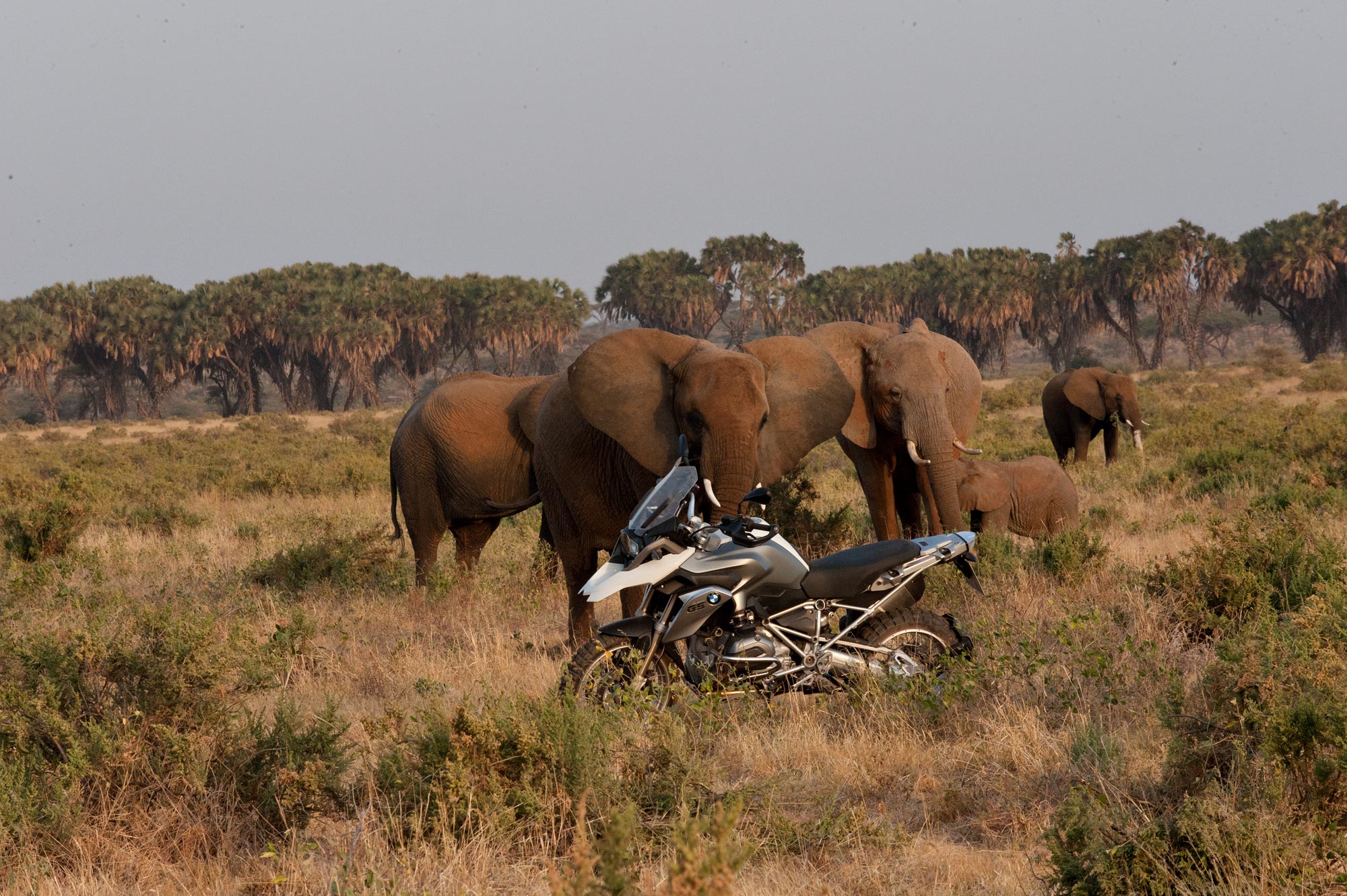
2013 BMW R1200GS

2013 BMW R1200GS
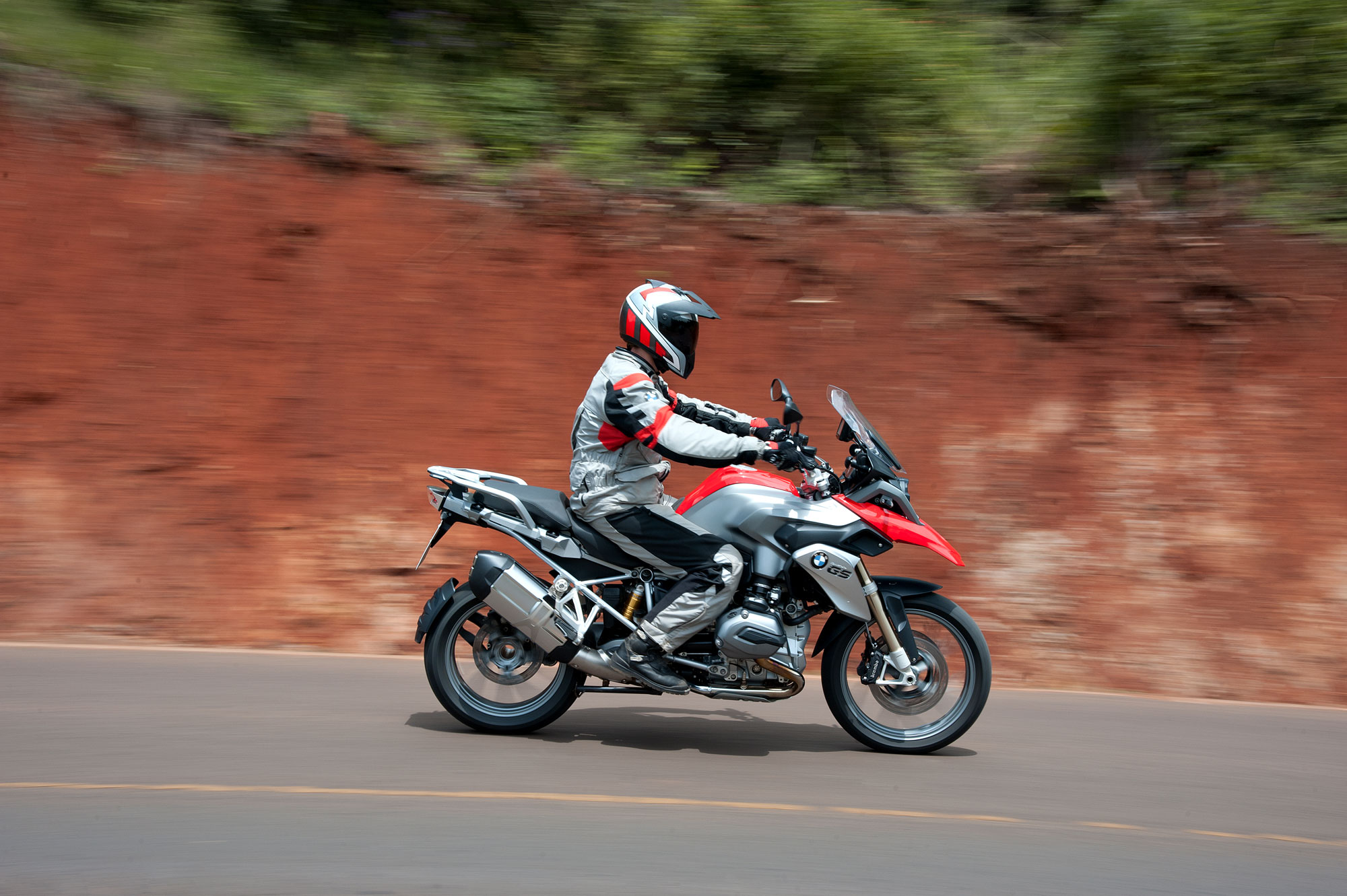
2013 BMW R1200GS
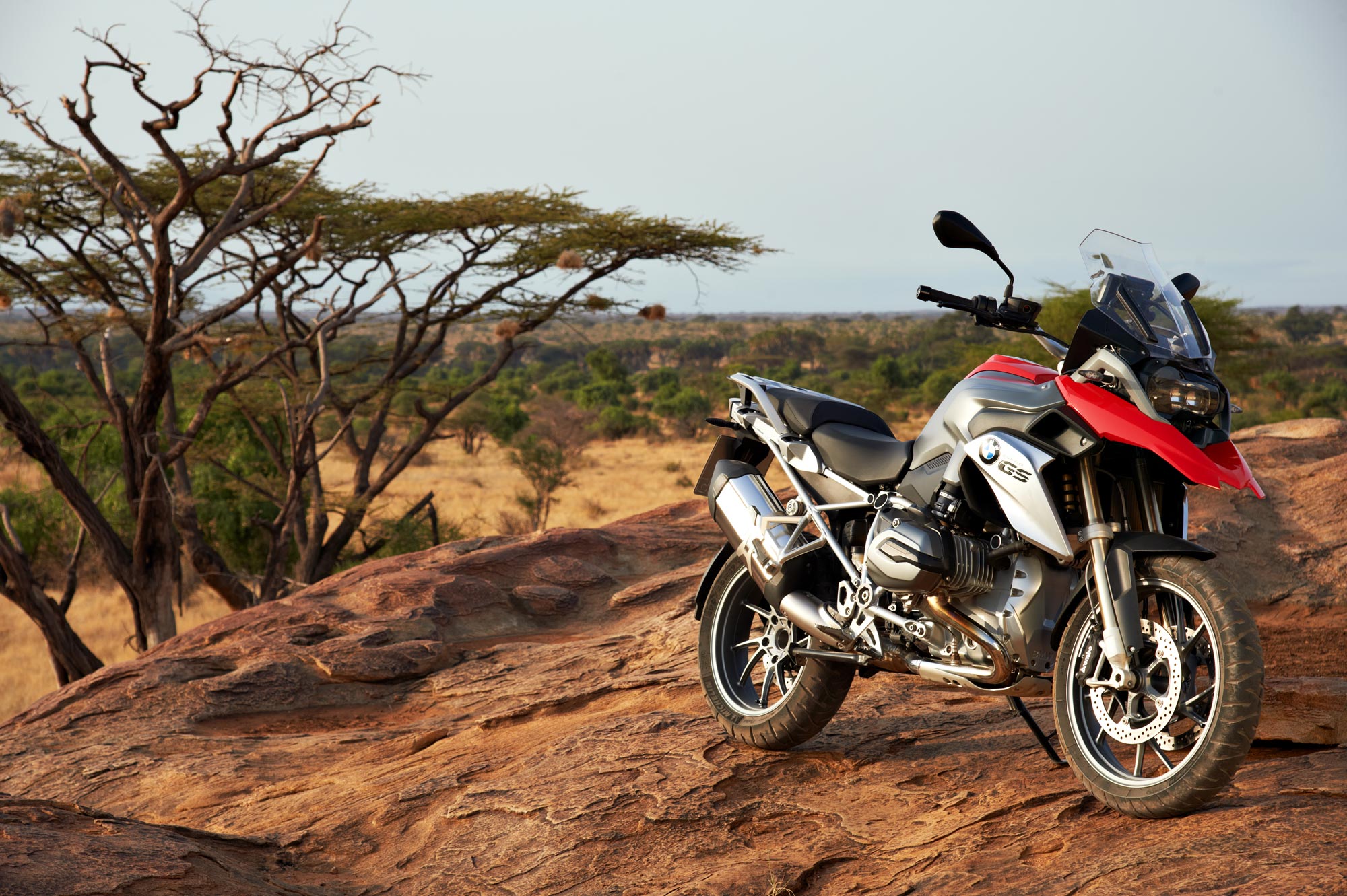
2013 BMW R1200GS
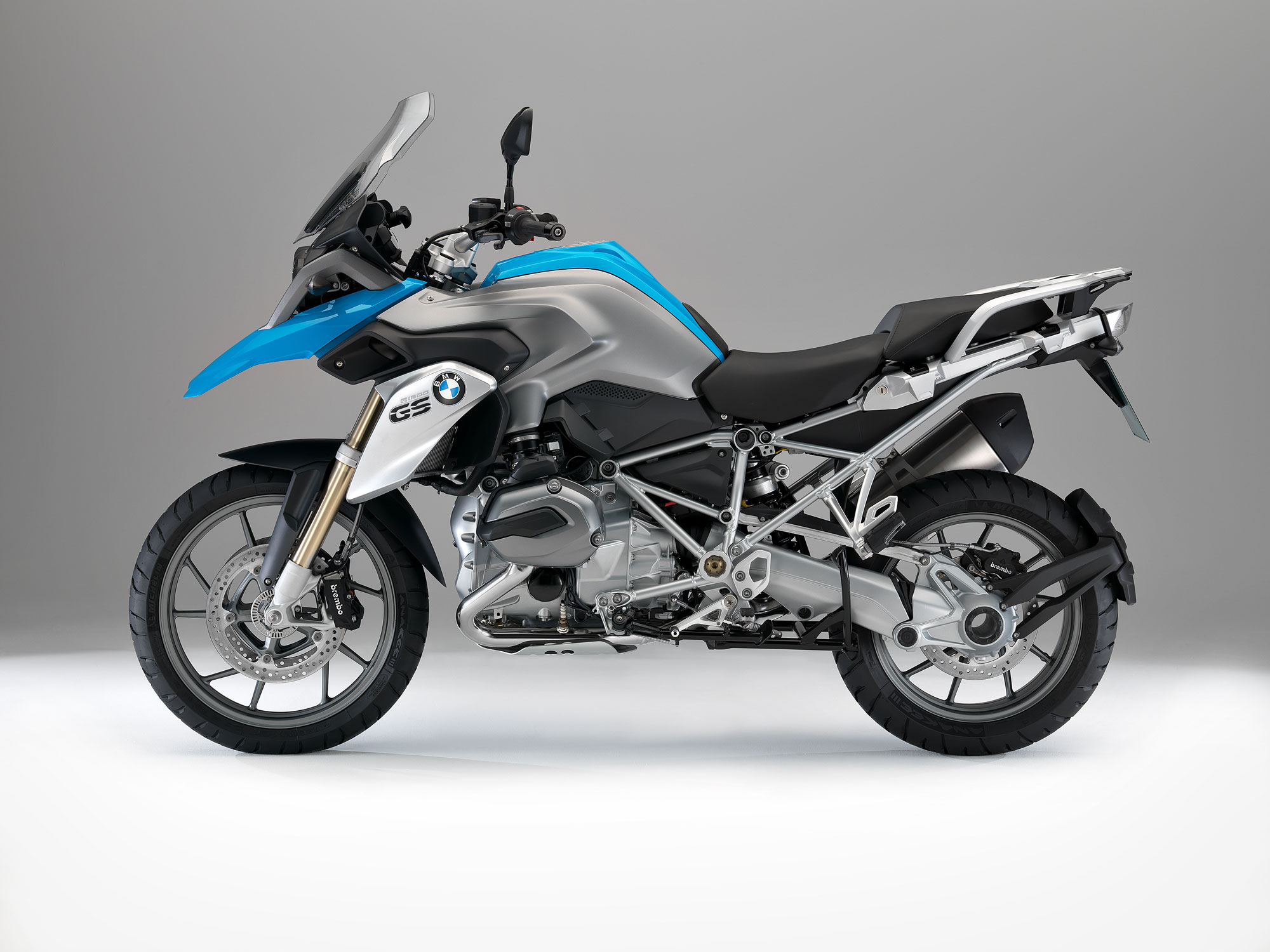
2013 BMW R1200GS

2013 BMW R1200GS

2013 BMW R1200GS

2013 BMW R1200GS with accessories
2013 BMW R1200GS Review
2013 BMW R1200GS
One R 1200 GS. One Mission – The best GS of all times.
The BMW R 1200 GS – the icon of all travel enduros. For 32 years “the GS” has been defining its segment and has proven to be the trusty companion on any motorcycle adventure. BMW Motorrad is now embarking on a new chapter of its success story and is yet again perfecting the iconic R 1200 GS.
One R 1200 GS. One Feeling – Power in every situation.
Powerful, refined, and high revving. The R 1200 GS is powered by a new opposed twin engine design delivering 125 hp. Based on a new concept of combined air and liquid cooling and vertical flows through the cylinders, the engine operates efficiently, reliably, and with high torques at all times. Further improvements like the new wet clutch with antihopping feature, the electromotive throttle actuator E-Gas, and the optional “riding modes” make the opposed twin engine the perfect drive solution at the heart of the new R 1200 GS.
One R 1200 GS. One Emotion – Supreme control
The new R 1200 GS is ready for any terrain, thanks to the greater rigidity of its main frame and its enhanced Paralever and Telelever for even greater enduro steering accuracy. The optional Dynamic ESA configures the suspension automatically to the terrain and load conditions. The GS provides even more functions with the optional “riding modes”, a set of four different configurations that can be selected at the push of a button.
One R 1200 GS. One Impression – Strong individuality.
At first glance, the “new one” too is a genuine GS: robust, dynamic, and full of character. New body panels with a perfect finish underscore its high quality character. The new cooling concept was integrated seamlessly into the distinctive design, and the visual emphasis moved to the front. The new R 1200 GS now gives the impression of more balance and power. Thanks to its extensive range of options, the R 1200 GS is absolutely unique. With an innovative, unique LED headlamp, cross spoke wheels, and a wide choice of options and packages, everyone can convert this enduro into “his” or “her” GS.
One World. One R 1200 GS – The tour of your life.
At the launch of the new R 1200 GS, BMW Motorrad will be setting a unique test ride in motion. In the “One World. One R 1200 GS.” event, BMW Motorrad will be sending five enduro adventurers on the redefined icon R 1200 GS on five tours all around the world. The first of its kind in the world, this project will be putting “the new one” to a gruelling test – and, with a little luck, give you too the opportunity for the tour of your life.
The “BMW GS” concept has embodied riding pleasure and the desire for adventure for over 30 years. This applies especially to the GS motorcycles with the opposed-twin “boxer” engine. The “big GS” allows motorcyclists to explore the most remote corners of the world – an idea that has already inspired numerous globetrotters to set off on their travels.
But the GS was and still is much more than this. Whether sports-style cornering on winding country roads, excellent travel times due to high motorway speeds, relaxed tours with a passenger or daring rides over rough terrain – every GS has offered supreme mastery of these skills in its respective era and this won’t change with the new version.
It is the unique integrated concept of the big travel enduro bike with boxer engine, complete with authentic charm and a powerful, high-torque engine, which is loved by legions of motorcycle fans all over the world to this day. It is not for nothing that the “big BMW GS” with boxer engine has been the undisputed frontrunner in its market segment for many years and is the best-seller within the BMW Motorrad model range. BMW is now beginning a whole new chapter in GS history: the most popular travel enduro in the world has been brought to perfection.
The challenge: how to improve even more following nine years at the top.
Even in its ninth year of production, the current BMW R 1200 GS is still setting the benchmark in its segment in comparative tests with its outstanding overall concept and innovative technology. With over 170,000 units sold, it is the most successful and top-selling travel enduro in the world.
So the challenge facing the BMW Motorrad development department was considerable: to further optimise the GS – an icon of three decades – improve it in all areas and equip it with innovative technical solutions to ensure it is in good shape for the future.
2013 BMW R1200GS Features and Benefits
The development goals of the new BMW R 1200 GS:
• Further increase performance overall – without neglecting its well-established virtues.
• Perfect its touring suitability.
• Increase off-road suitability.
• Achieve superior figures within the travel enduro segment and beyond in terms of engine and riding performance.
• Ensure preparation for the future in terms of noise and exhaust emissions.
• Suspension with top handling, optimum traction and increased off-road performance.
• Increase active and passive safety.
• Unmistakable BMW Motorrad design in typical GS style.
• Top quality as is characteristic of BMW Motorrad.
Newly designed air/water-cooled boxer engine with vertical through-flow, integrated gearbox and left-hand cardan shaft drive.
Geared towards the above goals, the entire R 1200 GS was completely redefined, particularly the drive concept.
The performance aspired to, as well as adherence to future anticipated requirements in terms of noise and exhaust emissions, is ensured among other things by a change in the cooling system. The boxer engine in the new R 1200 GS continues to use air/liquid cooling, however, the coolant oil has been replaced by a glycol-water mixture. This ensures a high level of heat absorption capacity of the cooling liquid for more efficient heat dissipation.
So-called precision cooling (a principle similar to that used in Formula 1) involves only those engine elements being cooled with coolant, which are particularly exposed to thermal stress. The engine still continues to use air cooling, thereby preserving the characteristic appearance of the opposed twin boxer engine. The two radiators are small and inconspicuously integrated.
The through-flow is now vertical instead of horizontal for improved filling, and the engine housing integrates the 6-speed gearbox as well as a wet clutch with anti-hopping function instead of the dry clutch as was used previously. What is more, the secondary drive now runs via the well-established cardan shaft on the left-hand side. With an output of 92 kW (125 bhp) at 7700 rpm and 125 Nm at 6500 rpm, the new engine offers superior power and performance in the travel enduro segment and beyond.
The empty weight (ready for the road) according to DIN of the R 1200 GS is 238 kg including standard BMW Motorrad Integral ABS.
E-gas and cruise control.
An electromotive throttle actuator is now used for the first time in a GS motorcycle. Here, rider commands are passed on directly by the sensor in the accelerator twist grip to the engine control system; this then regulates the throttle valve electronically. The use of the E-gas system provides a significant improvement in terms of controllability and response. What is more, the rider can adapt engine characteristics to the situation on the road by means of five modes (optional extra). It was also possible to include an electronic cruise control function (optional extra).
ASC and riding modes as an optional extra: five freely selectable modes – “Rain”, “Road”, “Dynamic”, “Enduro” and “Enduro Pro”.
For optimum adaptation to the rider’s individual needs and purpose, the new R 1200 GS now offers five freely selectable riding modes for the first time: these are an ex works option and feature three different E-gas settings and with varying engine characteristics. Linked to this is Automatic Stability Control ASC with a special enduro configuration. If this option is chosen, BMW Motorrad ABS, ASC and – if installed – the semiactive suspension are all adapted to the respectiveprofiles of these five modes
Semiactive suspension: BMW Motorrad Dynamic ESA for optimum riding dynamics in every situation as an ex works option.
The new semiactive suspension BMW Motorrad Dynamic ESA (Electronic Suspension Adjustment) taps into a whole new range of possibilities as well as providing maximum riding safety and performance. Dynamic ESA monitors the vertical movement of front and rear wheel control as well as other parameters by means of a spring travel sensor in each position, and adapts the damping automatically to the situation depending on riding conditions and the manoeuvres being carried out. Damping adjustment at front and rear is effected by means of electrically controlled regulation valves.
New chassis with tubular steel bridge frame and specially adapted wheel/tyre dimensions of 120/70 R19 at front and 170/60 R17 at rear as a world first.
The chassis of the R 1200 GS uses a completely newly developed tubular all-steel bridge frame with a bolt-on rear frame. Along with the newly designed Telelever at the front and the EVO Paralever at the rear, this has resulted in a further significant increase in torsional stiffness and hence ride stability and steering precision. Optimised handling qualities are the result of refined master geometric chassis data, and a longer swingarm provides further improved traction – especially when riding over rough terrain.
A globally unique feature of the new R 1200 GS are the tyres in the sizes 120/70 R19 at the front and 170/60 R17 at the rear, specially adapted to improve performance.
Revised brake system with radially mounted Brembo Monobloc brake calipers and BMW Motorrad Integral ABS as standard.
The brake system of the R 1200 GS has been extensively revised, too. There are now radially mounted Brembo Monobloc brake calipers at the front and a larger brake disc at the rear.
In line with the BMW Motorrad principle “Safety 360°” the new GS is also fitted as standard with the BMW Motorrad ABS, here in the part integral version.
The first motorcycle in the world with LED main headlight including integrated daytime running light for even greater safety when riding during the day and at night as an ex works option.
Even in its standard trim the new R 1200 GS has a main headlight with optimised light efficiency. In order to be seen even better during the day, BMW Motorrad also offers a daytime running light as an ex works option. For excellent road illumination and therefore even greater safety both day and night, an LED main headlight with integrated daytime running light is fitted in a motorcycle for the first time ever. It comprises innovative LED technology with a sophisticated cooling and decondensation concept.
Electrical system with new vehicle power supply and Multi-Controller for the BMW Motorrad Navigator IV.
The new R 1200 GS has the innovative new vehicle power system with altered function partitioning as already used in the 6-cylinder models K 1600 GT and GTL. As before, CAN bus (Controller Area Network) and LIN bus technology (Local Interconnect Network) enables significantly reduced wiring as compared to a conventional system. The previous central vehicle electronics has been partitioned into two separate control units.
The Multi-Controller, newly available for the GS, allows fast and convenient operation of the BMW Motorrad Navigator IV. It is located on the inside of the handlebar grip. This means that selecting functions is much less distracting than pressing buttons and does not require hands to be removed from the handlebars.
Aerodynamically optimised windshield with one-hand operation and optimum ergonomics.
The newly developed windshield of the R 1200 GS offers further improved wind and weather protection while also reducing wind noise. Adjustment is simple: an easily accessible and ergonomically optimised selection wheel is operated using one hand.
The new R 1200 GS has extended adjustment options for optimum seating comfort. The rider’s seat can now be adjusted in height and tilt angle and the passenger seat can be shifted longitudinally to obtain the ideal distance between rider and passenger. The new handlebars can easily be turned upwards and, together with the optimised knee grip in the fuel tank area, they ensure an even better standing position for off-road riding. The improved knee grip can be clearly felt when seated, too. A high and a low seat, as well as an adjustable footrest system and adjustable foot controls, round off the program of special accessories offering individual adjustment facilities.
An overview of highlights of the new BMW R 1200 GS.
• Completely newly designed engine for top-level riding dynamics within the travel enduro segment.
• Capacity 1170 cc, rated output 92 kW (125 bhp) at 7700 rpm and a maximum torque of 125 Nm at 6500 rpm.
• Cylinder heads with vertical through-flow for increased efficiency and performance.
• Compact air/water cooling for optimum heat management.
• Basic engine with compact, light and yet rigidity-optimised crankshaft.
• Vertically separated case in open deck construction.
• 6-speed gearbox integrated in engine housing, including wet clutch with anti-hopping function and reduced lever operation force.
• New intake system for optimum output and torque with 52 mm throttle valve diameter.
• E-gas for improved ridability, running smoothness and special functions.
• Innovative exhaust gas system with electronically controlled exhaust flap for optimum performance characteristics and an earthy boxer sound.
• Freely selectable riding modes “Rain”, “Road”, “Dynamic”, “Enduro” and “Enduro Pro” with three different electromotive throttle actuator settings in conjunction with ASC (Automatic Stability Control), ABS and ASC settings for off-road riding as well as different mode-specific Dynamic ESA settings (option ex works).
• New suspension with torsionally stiff tubular steel bridge frame and bolt-on rear frame.
• Optimised lightweight cardan shaft drive now running on the left-hand side.
• Newly developed and optimised Telelever at front and EVO Paralever at rear for an even more precise ride feel.
• Refined master chassis geometry data and long swingarm for excellent traction.
• Optimised seating width and position, and adjustable handlebars for even greater comfort.
• Optimised ground reach for rider (inner leg length).
• Tyre/wheel dimensions of 120/70 R19 at front and 170/60 R17 at rear as a world first, tailored specially to the R 1200 GS.
• Revised BMW Motorrad brake system with radially mounted Brembo Monobloc brake calipers at front and 2-piston floating caliper with enlarged brake disc at rear (Ø 276mm, previously 265mm).
• BMW Motorrad Integral ABS as standard.
• Semiactive suspension Dynamic ESA (ex works option).
• Main headlight with optimised light efficiency and LED daytime running light (ex works option).
• World’s first motorcycle with LED main headlight featuring integrated daytime running light (ex works option).
• New vehicle electrical system with partitioning of functions.
• Extended electric switch units.
• Electronic cruise control (ex works option).
• Preparation for navigation unit with Multi-Controller to operate the BMW Motorrad Navigator IV (ex works option).
• Windshield with one-hand operation for excellent wind and weather protection.
• Seat with multiple adjustment functions for perfect ergonomics.
• Number plate carriers quick to dismount for off-road riding.
• Increased ground clearance (+ 8 mm)
• New instrument cluster with on-board computer as standard. PRO on-board computer as an option.
• Four main paint finishes to choose from:
Alpine White, Racing Red, Blue Fire and Thunder Grey Metallic.
· Extensive range of special accessories and rider equipment.
2013 BMW R1200GS Key Features
Completely newly designed engine for maximum riding dynamics in the travel enduro segment.
Like all engines in BMW motorcycles, the details of the boxer engine in the R 1200 GS are based on a carefully conceived overall concept. Designed to perpetuate the almost 90-year tradition of the BMW boxer engine with a future-oriented concept created to hold good for years to come, the engine reproduces numerous classic engineering features but also offers a wealth of new technical solutions. The strengths of the boxer have been further refined for the new BMW R 1200 GS so as to achieve a greater breadth of application in terms of touring suitability, dynamic performance and off-road qualities.
While the previous boxer power unit itself provided supreme forward thrust in all situations, the new BMW R 1200 GS takes a significant step further. With its completely redesigned engine it offers a much higher level of dynamic performance, acceleration and pulling power across the entire engine speed range, both on the road and over rough terrain.
The totally newly developed 2-cylinder opposed-twin in the R 1200 GS has a capacity of 1170 cc as in the predecessor model. The ratio of bore to stroke of 101 to 73 millimetres has also been preserved. The rated power output is 92 kW (125 bhp) at 7700 rpm, and its maximum torque of 125 Nm is available at 6,500 rpm.
The foremost development goals for the new engine were top-level riding dynamics within the segment, characteristics favouring both sporty and touring requirements, optimum ridability, compact dimensions and the lowest possible weight.
The empty weight (ready for the road) according to DIN of the R 1200 GS is 238 kg including standard BMW Motorrad Integral ABS. Compact air/water cooling for optimum heat management.
The performance aspired to, as well as adherence to future anticipated requirements in terms of noise and exhaust emissions, is ensured among other things by a change in the cooling system. The boxer engine in the new R 1200 GS continues to use air/liquid cooling but the oil coolant has been replaced by a glycol water mixture for the first time in a BMW Motorrad boxer engine. This ensures a high level of heat absorption capacity of the coolant for more efficient heat dissipation.
So-called precision cooling means that the cooling fluid flows through the thermally more heavily exposed engine elements – the two cylinder heads and parts of the cylinders. Heat dissipation is via two radiators positioned at the left and right of the front section. These are inconspicuously integrated and well protected by the radiator covers. An electric fan behind the right-hand radiator is automatically activated as needed, controlled by the thermostat – for example at high outdoor temperatures in city traffic. Thanks to the sophisticated cool-air ducting on both sides, the warm air is streamlined past the rider.
The engine still also uses air cooling which reduces radiator size and preserves the characteristic appearance of the boxer engine.
With the new very compact cooling system, it has been possible to significantly improve the cooling ratio and thus the heat management system as compared to the predecessor model (22 % oil cooling / 78 % air cooling) in the new BMW 1200 GS (35 % liquid cooling / 65 % air cooling). The new liquid cooling adds weight to the vehicle as compared to the previous air/oil cooling system, but due to its very compact size and high efficiency, this is only a very moderate addition of approx. 2.7 kilograms. Cylinder heads with vertical through-flow for increased efficiency and performance.
The engine of the new BMW R 1200 GS has vertical through-flow unlike all previous standard BMW Motorrad opposed-twin engines. The advantage is that the design of the intake channel no longer depends on the camshaft control, so it was possible to realise identical intake lengths for both cylinder sides. What is more, the fuel injector in the intake port is now arranged so that the fuel can be injected as squarely as possible in front of the intake valves for optimum carburetion. The result is a higher level of power and torque efficiency across the entire engine speed range as well as improved fuel efficiency.
As in the predecessor model, the two camshafts made of heat-treated steel are arranged horizontally. By changing the through-flow direction from horizontal to vertical, however, it is now possible to have purebred intake and exhaust camshafts – in the predecessor model these were combined intake/exhaust camshafts. This also opens up the possibility of adding variability to the valve gear in future. Newly calculated cam profiles allow a reduction of overlap time without impacting on performance.
As before, the two respective camshafts are driven by a chain running in the shaft behind the cylinders (on the right-hand side of the engine from the counterbalance shaft and on the left from the crankshaft). The timing chain drives an intermediate shaft between the intake and exhaust camshaft and it is from here that power is transmitted to the camshafts via spur gear pairs. At each exhaust camshaft there is an centrifugal-force-driven decompression facility which facilitates the start-up process. This makes it possible to save weight in the starter motor and battery.
Compared to the hitherto horizontal through-flow of the cylinder heads, the vertical through-flow permits an optimally straight intake port with a correspondingly simple chain guidance of the camshaft drive.
Due to the highly efficient overall design of the power unit, the previous radial valve arrangement is no longer required. At 8 degrees on the intake side and 10 degrees on the exhaust side, the four valves are at close angles to one another, making for a compact combustion chamber shape – a feature which is crucial to optimum combustion. Due to the new calculation of the combustion chamber and the much improved channel ducting and design, it has been possible to improve the compression ratio as compared to the predecessor model from 12.0:1 to 12.5:1. What is more, due to the optimisation of the combustion process and ignition timing, no knock control is required, despite retaining the RON 95 set-up, while still making the most of torque potential.
The use of a turbulence system (air feed via a bypass) ensures optimum combustion, obviating the need for an elaborate dual ignition.
The plate diameters of the valves have also been redefined to obtain higher output and torque efficiency. They are 1.0 millimetres larger, with a size of 40 millimetres on the intake side and 34 millimetres on the exhaust side. The valve stem diameter is still 5.5 millimetres as before. Significantly shorter valve springs do justice to the increased engine speed level, while also ensuring an optimally defined drag effect.
As before, the valves are operated via light, speed-resistant rocker arms, the design of which was derived from the high-performance 4-cylinder engine of the BMW S 1000 RR. The valve clearance settings are made by means of replaceable shims. With 0.10 to 0.17 millimetres on the intake side and 0.34 to 0.41 millimetres on the exhaust side, valve clearance levels are just below those of the predecessor model.
Basic engine with compact, light and yet rigid crankshaft.
The crankshaft has also been completely re-engineered. The main bearing diameter was reduced from the previous 60 millimetres to 55 millimetres to reduce the drag forces. The crankshaft also has crankpins which are narrower but with a diameter enlarged from 48 to 50 millimetres as well as narrower main and guide bearings. As a result, it is lighter overall yet much stiffer and more compact.
Although the boxer principle, with its opposed cylinders, offers mutual cancelling out of the free mass-forces (due to the rods and pistons moving back and forth), there is still a certain amount of residual vibration. This results from the unavoidable parallel offset of the two cylinder axes, meaning that the forces do not act precisely on the same level and resulting in a so-called rotating mass moment of inertia.
This rotating mass moment of inertia has been significantly reduced by means of a more compact crankshaft design, but it was not possible to eliminate it completely. As in the existing boxer engine of the R 1200 GS, the new engine therefore also has a counterbalance shaft which runs at crankshaft rotation speed with newly defined imbalance masses so as to eliminate unwanted vibrations. The counterbalance shaft is designed as a hollow intermediate shaft within which the clutch shaft runs. This ensures that the new engine of the R 1200 GS, with its higher engine speed level, runs more comfortably and with perceptibly less vibration across the entire engine speed range and at high engine speeds in particular. Nonetheless, the essential earthy boxer characteristics are still preserved.
Vertically separated case in open deck construction.
For the first time in a BMW Motorrad boxer engine, the cylinders are no longer separately bolted to the crankcase, but are integrated directly. The dual-section die-cast cylinder crankcase with vertical split level at the centre of the crankshaft is made of highly rigid aluminium alloy. The two case halves form a highly rigid composite consisting of the cylinder and the bearing block for the crankshaft.
The cylinder with cooling jacket is designed in open deck form. The liners are coated with a low-wear and low-friction iron-carbon alloy using the new wire arc spray process (LDS) already used for BMW automobile engines.
Gearbox integrated in engine housing for the first time, including wet clutch with anti-hopping function.
For the first time in the history of BMW Motorrad, the gearbox and clutch are integrated in the engine housing of a boxer engine. This provides benefits in particular in terms of weight balance due to the omission of numerous bolt connections and sealing surfaces, but also in terms of the torsional response of the unit as a whole. In addition to saving space and weight, the new gearbox (two transmission shafts, one drive shaft, one output shaft) means there is no longer any need for the additional transmission oil volume previously required for lubrication.
The 6-speed gearbox of the new R 1200 GS was also redefined to meet the demand for light, precise shifting and optimum gearshift connections so as to achieve excellent riding dynamics. As a result, the ratios were newly calculated.
As before, a helical gearing system is used for the gearwheels which ensures low running noise and a high level of running smoothness due to smooth tooth engagement. As before, the gear shafts of the new engine are mounted on anti-friction bearings and the gearwheels (idlers) run smoothly on needle roller bearings. Shifting of the gearwheels and therefore of the gears is effected by means of a ball-bearing mounted selector drum made of steel, three case-hardened gearshift forks with hard chrome-plated ends and sliding sleeves with force-fitting connections between the gearwheel pairs.
The new R 1200 GS is the first serial production BMW Motorrad boxer motrcycle to have a multiplate wet clutch with eight friction discs instead of the previous single-disc dry clutch. The benefits of this solution lie in the reduced moment of inertia, on the one hand due to the significantly reduced external diameter of 147 millimetres (R 1200 GS previously: 180 mm), but also in its more compact size.
For the first time in conjunction with a boxer engine, the clutch system is fitted with an anti-hopping mechanism. Here, BMW Motorrad especially addresses the needs of ambitious riders of the new R 1200 GS travelling on country roads. The brake torque of the engine is now passed to the rear wheel at a reduced level during coasting. This prevents brief blocking or hopping of the rear wheel due to the dynamic wheel load distribution when applying the brakes heavily and changing down at the same time. In this way, the motorcycle remains stable and safely controllable in the braking phase. Clutch disengagement during coasting is effected mechanically by means of a ramp mechanism. The clutch is activated hydraulically.
The practically oriented level of hand force and finely sensitive controllability provided by hand force enhancement in the clutch ensure that the high standards of BMW Motorrad are met in terms of operation and comfort. In conjunction with the sensitive throttle response, this makes for optimum vehicle control on all types of terrain.
New intake system for excellent output and torque.
For more than two decades now, BMW Motorrad has occupied a leading position in the field of electronic engine management, and in the case of the new R 1200 GS this is taken care of by the new digital engine control system, the so-called BMS-X.
Its main features are fully sequential injection, a compact layout and low weight. The Alpha/n-based engine management system with torque interface draws on a wide range of parameters. For example, it enables perfectly controlled torque output and adaptation of response to a diverse range of conditions via the E-gas characteristics attributed to the various riding modes. The control system is based on the volume of intake air which is determined indirectly via the throttle valve angle and the engine speed. Based on additional engine and environmental parameters (including engine temperature, air temperature and environmental air pressure), the engine control system determines individually adapted levels for injection volume and ignition timing together with stored mapping characteristics and pre-set correction functions.
Carburetion is taken care of by an electronic fuel injection system via a throttle valve body system with an opening width of 52 millimetres instead of the previous 50 millimetres. Newly designed, markedly raised intake air snorkels and a generously sized airbox with panel air filter element ensure optimum feeding of cool intake air and thus optimum filling.
E-gas for improved ridability, running smoothness and special functions.
An electromotive throttle actuator system is used to control the two throttle valves. Here the rider’s commands are passed on directly from the sensor in the accelerator twist grip to the fully electronic engine control system and converted into a throttle valve position as appropriate to the riding mode selected by means of instant electronic adjustment.
The electromotive throttle actuator in the new BMW R 1200 GS allows improved ridability and optimised running smoothness in the near-idling range since the engine control detects any differences between the two cylinders in terms of mean pressure and compensates by means of selectively adapting the throttle valve angles. Furthermore, in conjunction with the optional ASC and riding modes, different throttle response characteristics can be set (soft, optimum, direct) according to the intended purpose.
Much improved controllability has enabled a reduction of twist grip angle from 85 to 70 degrees. Another advantage of this technology is the realisation of a cruise control function as a comfort option. Electronic cruise control.
The new R 1200 GS is the first BMW GS to be available with an electronic cruise control function fitted ex works – making lengthy motorway rides more relaxed and comfortable, for example. The function is activated by pressing a button at the left-hand end of the handlebars, while a shift paddle is used to increase or reduce the currently selected road speed. Here the two throttle valves are activated by the engine control and independently of the accelerator twist grip.
When the front or rear brake or the clutch are activated or the throttle grip is turned in the opposite direction (starting from the idling position) cruise control is switched off. The “Resume” function allows the rider to re-activate the originally selected speed, which the vehicle then automatically restores. As long as the drag torque in the currently selected gear is sufficient, the electronic cruise control function works on hill descents, too.
Innovative exhaust gas system with electronically controlled exhaust flap for optimum performance characteristics and an earthy boxer sound.
The exhaust system of the new R 1200 GS is made entirely of stainless steel and geared completely towards optimum performance characteristics, operating according to the 2-in-1 principle. In this development area, homogeneous output and torque curves and thus excellent ridability were once again regarded as requirements for supreme performance on country roads, off-road riding and extended touring.
The two manifold tubes and the interference pipe were redesigned in terms of shaping, length and diameter. The new BMW R 1200 GS meets the demand for a particularly earthy yet still legally compliant boxer sound with an exhaust flap controlled by an electric motor along with opening and closing cables. In order to reduce ram pressure and ensure a full sound, the rear silencer – now positioned on the right-hand side – has a completely newly engineered interior structure, which uses a combination of reflection and absorption silencing.
Exhaust emissions are regulated by means of an oxygen sensor controlled catalytic converter. In this way the BMW R 1200 GS meets current exhaust emissions standards and is designed to meet future standards, too.
Optimised lightweight cardan shaft drive with EVO Paralever swingarm now running on the left-hand side.
For 90 years, BMW Motorrad has used the universal-shaft drive as a logical consequence of longitudinal crankshaft mounting – the optimum maintenance-free form of power transmission for a travel enduro.
In contrast to all previous BMW Motorrad boxer models, the swingarm with integrated cardan shaft drive and EVO Paralever (in its third generation and designed using the very latest calculation methods) is now positioned on the left-hand side. This avoids any contact between the rider and the hot exhaust system when pushing or getting on and off the machine. Another pleasing effect relates to the appearance of the vehicle: when the motorcycle is on the side stand there is now a clear view of the redesigned rear wheel. A newly calculated set of bevel/crown gears for the drivetrain meets increased output and torque requirements. In the tried and tested manner, the Paralever swingarm decouples the unavoidable reactive torque of the drivetrain from the swingarm and therefore from the suspension/damping system by means of an additional joint between the rear axle cover and the swingarm. This effectively eliminates the undesirable “elevator effect”, i.e. the rising and lowering of the rear when accelerating and decelerating.
As part of the complete redesign of the drive system, there has also been a comprehensive reduction of clearance from the primary drive to the drivetrain, causing the enhanced engine performance to act more directly on the rear wheel.
ASC and riding modes as an optional extra: five freely selectable modes – “Rain”, “Road”, “Dynamic”, “Enduro” and “Enduro Pro” with three different characteristic throttle curves.
In order to suit various purposes such as riding on the road, on wet surfaces or over rough terrain, an ex works option is available to the rider of the new R 1200 GS which comprises five different riding modes with three different E-gas settings, three different ABS settings and four ASC settings. To make the required setting, the “Mode” switch on the right of the handlebar unit is activated until the display in the instrument panel shows the desired riding mode. It is also possible to implement the rider’s command during travel: the mode change is made by moving the throttle twist grip to idle with the clutch lever pulled. When the motorcycle is restarted, the last selected setting is always maintained.
The optional feature includes Automatic Stability Control (ASC) in a special enduro configuration for the “Enduro” and “Enduro Pro” modes. A special enduro configuration for the standard BMW Motorrad ABS is also featured – this is also used in the “Enduro” and “Enduro Pro” configurations. Dynamic ESA as an optional feature is then also integrated in the system of modes. Suspension set-up is adjusted precisely depending on the riding mode selected (see Suspension section).
When riding on wet surfaces or in difficult grip conditions, “Rain” mode provides especially soft dosage and response characteristics to support the rider, though full torque and output potential are still retained. The electronic control system ASC (Automatic Stability Control) responds more readily than in “Road” mode. If the Dynamic ESA option is selected, the damping of the spring struts at front and rear is softer, in keeping with the conditions.
In “Road” mode, the control systems are set to ensure optimum performance on dry roads. This mode provides a spontaneous, linear throttle response on dry roads. “Road” combines sound, supple controllability with a homogeneous build-up of torque.
“Dynamic” mode reveals the sportiest face of the new BMW R 1200 GS for road riding. An even more spontaneous and direct throttle response, more restrained ASC intervention and tighter damping in the case of the Dynamic ESA option bring the full potential of the machine to bear.
The “Enduro” mode enhances the R 1200 GS for off-road riding. A soft throttle response, restrained control intervention on the part of the Enduro ASC, optimum brake distribution and ABS control in conjunction with the high-traction set-up of the optional Dynamic ESA get the motorcycle ready to explore new enduro worlds. This means that even motorcyclists with limited enduro experience will quickly get their off-road bearings on the new R 1200 GS and enjoy lots of riding fun. The mode is optimised for use with standard tyres.
For more ambitious enduro riders, BMW Motorrad offers the “Enduro Pro” mode. This riding mode provides spontaneous engine response characteristics and is designed for use with studded tyres. At the same time, the ABS function is disengaged at the rear by pressing the footbrake lever; the optional Dynamic ESA shifts into traction-oriented and optimum bottom-out set-up. ASC is set to professional enduro mode and permits considerably more slip. In this configuration, the sporty face of the new BMW R 1200 GS is revealed off-road, too, and the experienced enduro rider can move into an added dimension of riding fun due to further improved controllability of the machine.
New chassis with torsionally stiff tubular steel bridge frame and bolt-on rear frame.
One of the primary goals in developing the new BMW R 1200 GS was to further increase the bike’s high level of riding dynamics while also creating a suspension which would extend the possible range of uses of the “big GS” both on and off the road. The new, more rigid main frame including the steering-head bearing for the Telelever and the swingarm axle of the EVO Paralever has made it possible to significantly improve ride stability, handling and precision.
The bike also benefits from the improved suspension/damping set-up in terms of touring suitability, since lengthy trips are now more comfortable and less tiring for this reason.
The optimised connection with the road surface, especially due to the new suspension/damping set-up and the new wheel/tyre dimensions, means that the new R 1200 GS is also considerably more dynamic. Its precise handling allows the motorcyclist to adopt a very sporty style while retaining full controllability and without requiring excessive physical effort.
Off-road the rider of the new R 1200 GS benefits from a tighter connection with the ground, too, as well as appropriately adapted control strategies which generate a much greater sense of trust in the vehicle.
While the frame of the R 1200 GS previously consisted of an upper frame to support and position the Telelever and the rear frame with integrated swingarm mount and welded on rear section, the chassis of the new R 1200 GS is now made of a continuous steel bridge frame with a bolt-on rear frame. The latter offers particular benefits in terms of maintenance. However, the integration of the engine as a load-bearing element has been retained as this is beneficial to the bike’s weight and rigidity.
CHASSIS
Optimised Telelever at front and EVO Paralever at rear for an even more precise ride feel.
As before, the triangular swingarm in forged aluminium is supported by the engine housing. The outstanding underlying principle of this type of front wheel control is the fact that it relieves the telescopic control of longitudinal and transverse forces as well as separating wheel control from suspension and damping, resulting in an unsurpassed degree of sensitivity of response in the front section. A high level of ride precision and directional accuracy combined with excellent ride comfort and anti-dive control are the fundamental advantages of this design.
The Telelever has been geometrically refined for use in the new R 1200 GS, and its excellent properties have been further optimised. While retaining the same degree of rigidity, the fork tube diameter of the telescopic control was reduced from 41 to just 37 millimetres. This means that in spite of integrating radiators in this area, it was still possible to retain the existing steering angle of +/- 42 degrees, ensuring excellent manoeuvrability and slow riding. In combination with a more rigidly designed trailing arm, the overall result was even higher steering precision and transparent feedback in the front section. As before, the entire Telelever is designed to be maintenance-free with its encapsulated ball joints and permanent lubrication as well as a lifetime filling of the telescope tubes with oil.
In the patented rear wheel control system EVO Paralever it was possible to provide improved protection for the lower spring strut area against potential damage during off-road riding by means of the wrap-around swingarm. Due to its more rigid housing in the main frame, the progressive damping spring struts at front and rear now respond much more sensitively as well as having considerably increased damping reserves. With progressive damping, the progression of the damping force depends on spring travel. On the one hand, it enables a very finely tuned response even to the smallest road bumps, yet it still offers plenty of potential for off-road use with harsher impacts and ground waves. In spite of the much enlarged swinging arm length, the torsional stiffness of the Paralever is the same as in the predecessor model.
At 190 and 200 millimetres, the spring travel at front and rear remains identical to the predecessor model. The share of positive and negative spring travel also remains the same. It is 122 to 68 millimetres at the front and 135 to 65 millimetres at the rear.
The rear spring strut has 12 rebound-stage damping adjustment settings and also a handwheel for adjusting the spring mount (“spring preload”) so as to enable continuously variable hydraulic adaptation to the personal needs of the rider.
The new R 1200 GS also meets the need for greater off-road suitability by offering increased ground clearance. This is now 195 millimetres – 8 millimetres more than before. The increased ground clearance was not achieved by extended rebound travel in the wheel control, but by adapting the conception of the vehicle as a whole.
Semiactive suspension: BMW Motorrad Dynamic ESA for optimum riding dynamics in every situation as an ex works option and BMW Motorrad Integral ABS as standard.
With the optional Dynamic ESA, BMW Motorrad offers an electronic suspension which taps into a whole new range of possibilities as well as providing maximum riding safety and performance. This semiactive suspension monitors the vertical movement of front and rear wheel control in travel and speed as well as other parameters by means of a spring travel sensor in each position and adapts the damping automatically to the situation depending on riding conditions and the manoeuvres being carried out by the rider. Dynamic ESA also responds to an ABS control brake manoeuvre, for example. Damping adjustment of the spring struts at front and rear is effected by means of electrically controlled regulation valves.
The drastically improved contact between road and tyres means that the new R 1200 GS is able to provide a previously unequalled sense of security on very uneven roads and when riding off-road.
Dynamic ESA does not work as a self-contained system, but is able to communicate with the other control systems of the R 1200 GS – BMW Motorrad ABS as well as Automatic Stability Control ASC – via CAN bus.
What is more, the basic settings of Dynamic ESA are linked to the riding modes “Rain”, “Road”, “Dynamic”, “Enduro” and “Enduro Pro”, which can be conveniently selected by the rider at the press of a button. Each of the riding modes gives the rider a damper setting as recommended by BMW Motorrad experts. The mode switch can be used to adapt the overall characteristics of Dynamic ESA, engine control (characteristics), ABS and ASC to the given situation by selecting the various modes with their respective settings. What is more, the damper setting can be tailored to personal preferences in all modes, ranging from “soft” to “normal” and “hard” by means of the “ESA” switch on the end of the left handlebar. The load settings for one person, one personal with luggage or two persons are also set using this switch, just as the rider prefers.
In “Rain” mode, the dampers have a soft basic set-up. In order to ensure maximum safety when accelerating, ASC is set for early control intervention in “Rain” mode. ABS is adjusted for use on the road.
If the rider selects the “Road” mode, Dynamic ESA shifts to a tighter setup. ASC ensures optimum traction on dry roads and the ABS is also configured for road use.
In “Dynamic” mode, Dynamic ESA provides an even tighter damper setting which is entirely geared towards a sporty style of riding on the road. In this profile, ASC characteristics are further tightened, even enabling experienced riders to perform light drifts. Here again the ABS setting is geared towards road use, while also providing a more dynamic throttle response.
The “Enduro” mode provides a high-traction damper setting for off-road riding. Here ASC provides for more slip on the rear wheel, allowing light off-road drifts. The ABS setting is designed for running over loose surfaces such as gravel with road tyres, which have a higher approved level of slip. As on the road, the ABS operates with a part integral function: in other words when the front wheel brake is activated, part of the brake force is directed to the rear wheel. This is a feature which offers a high level of safety over rough terrain, too. Here the control strategy is designed so that wheel lock is prevented while still allowing effective deceleration. Increased ride stability and a greater sense of trust are the pleasing result.
An additional coded plug enables the rider to access the “Enduro Pro” mode for more ambitious off-road riding. This setting provides significantly increased bottom-out reserves. In this mode – reserved solely for off-road use with studded tyres – experienced motorcyclists can deliberately make the rear wheel of the R 1200 GS break out due to ASC intervention adjusted to professional enduro use. The ABS characteristics are specially adapted to this type of sporty use since control is specifically geared towards riding on loose surfaces with studded tyres. What is more, ABS does not act on the rear wheel when the rear brake is applied. Deactivation of the part integral function means that the front and wheel brake operate entirely separately from one another, in keeping with the preferences of an experienced enduro rider, also allowing so-called initial brake drift before hairpin bends.
And when the coded plug is used, the individual Dynamic ESA setting is preserved over a change of riding mode. Without the coded plug all settings are set to default, e.g. when turning off the ignition. ABS and ASC can be manually disengaged by the rider in all modes. With the coded plug inserted, the systems remain deactivated when restarting the bike after having turned off the ignition before.
Refined master chassis geometry data and long swingarm for excellent traction.
Even the previous R 1200 GS offered top-level response, leaving virtually nothing to be desired in terms of handling, directional accuracy, steering precision and high speed stability. For this reason, the master chassis geometry has not been radically changed but merely slightly optimised. The steering head angle has increased slightly to 64.5 degrees. Wheel castor is virtually identical, having previously been 101 millimetres and is now 99.6 millimetres. The wheelbase of 1507 millimetres has remained unchanged.
The length of the swingarm has been considerably increased. Previously 535.6 millimetres in length (measured from the swingarm centre of rotation to the middle of the rear axle), the new figure is 588 millimetres. In practice, this extension translates mainly into improved traction and thus more effective transmission of drive forces for further improved performance. This is a benefit which particularly comes into play in off-road riding and therefore over loose surfaces.
New tyre/wheel dimensions of 120/70 R19 at front and 170/60 R17 at rear as a world first, tailored specially to the R 1200 GS.
In order to provide a fuller ride feel and more harmonious response, in conjunction with increased directional accuracy and performance when braking and accelerating, the wheel and tyre dimensions of the R 1200 GS were recalculated and defined over a number of highly involved development phases in collaboration with well-known tyre manufacturers.
The tyre dimension 120/70 R19 is used for the first time ever in a large enduro bike. As compared to the previous tyre size of 110/80-19, the tyres for the weight-optimised 10-spoke light alloy cast wheel enlarged to 3.0 inches (previously 2.5 inches) offer a larger contact area, which has the effect of producing higher levels of transferrable cornering and deceleration forces. But in practice, the rider benefits from more than just improved banking response and increased power transmission during braking. A special tyre contour tailored to the new R 1200 GS also guarantees maximum neutrality when cornering as well as the very highest level of riding precision.
A newly defined tyre is also used on the rear wheel of the R 1200 GS to enhance traction, cornering and ultimately riding dynamics, too. While the R 1200 GS previously had a 150/70 R17 tyre at the rear, a size 170/60 R17 tyre now ensures a significantly larger contact surface for better cornering and traction. In keeping with the new tyre size, the rim width of the likewise weight-optimised 10-spoke light alloy rear wheel has also been increased from 4.0 to 4.5 inches.
And in the R 1200 GS, too, the extensive BMW Motorrad options program allows these to be fitted with cross-spoke wheels, especially for increased off-road use. These have also been completely newly developed and are identical in size to the standard light alloy cast wheels. In the course of redevelopment, the light alloy rim was given a matt, robust and easily cleanable surface coating.
The weight-optimised hubs boast a finely wrought technical design and are connected to the rim by stainless steel spokes.
Revised brake system with radially mounted Brembo Monobloc brake calipers and BMW Motorrad Integral ABS as standard.
The BMW Motorrad brake system of the R 1200 GS – which like all BMW motorcycles is fitted with ABS as standard – has undergone extensive revision. Radially bolted Brembo Monobloc brake calipers with a piston diameter of 32 millimetres (previously: 34 and 36 millimetres) are now fitted. The diameter of the master cylinder of the handbrake pump has been reduced from 16 to 15 millimetres. The diameter of the two floating brake discs is 305 millimetres as before.
The rear single disc brake still has a 2-piston floating caliper with a piston diameter of 28 millimetres. Meanwhile, the diameter of the brake disc has increased in size from 265 to 276 millimetres.
Main headlight with optimised light efficiency and LED daytime running light as an ex works option.
Seeing and being seen as well as possible – these are crucial factors on which the safety and therefore fun of motorcycling depend. This is why BMW Motorrad also dedicated intense efforts to the development of a new lighting unit for the R 1200 GS.
The new standard halogen headlight is not only considerably smaller than the previous one. In terms of road illumination, too, it offers top-level lighting technology for both low and high beam. Intensive tests in the BMW Group lighting tunnel have generated light levels which – given the same light emission area – achieve significantly better results in terms of perceptibility and vision for night riding as compared to the competition.
BMW Motorrad offers an additional daytime running light with LED technology as an ex works option. The unit consists of four LED modules and is integrated underneath the main halogen headlight. The daytime running light allows other road users to differentiate the motorcycle much more clearly, thereby offering a huge safety benefit. What is more, the use of LED technology means a lower level of energy consumption and an extended lifetime. The daytime running light is switched on either automatically via a light sensor or manually instead of the main headlight using the “Daytime running light” switch. When darkness falls or when entering a tunnel, there is an automatic switchover to the halogen main headlight, providing optimum road illumination to ensure excellent visibility.
Electrical system and electronics.
The first motorcycle in the world with main headlight featuring full-LED technology including integrated daytime running light for even greater safety when riding during the day and at night.
For decades now, BMW Motorrad has been regarded as a frontrunner when it comes to issues of safety in connection with motorcycling. With its innovative strength, BMW Motorrad established itself as a trendsetter very early on and will continue to offer additional safety benefits for motorcycling.
The latest example of the innovative power of BMW Motorrad in this area is the first ever full LED headlight with integrated daytime running light to be used in serial motorcycle production, available as an option for the R 1200 GS. Globally unique, this LED main headlight with daytime running function illuminates the road with a level of brilliant clarity not previously known. The headlight’s LEDs are strikingly distinctive and powerful with their double glass lenses. The option also includes a rear light with two light bands, making for an even more high-quality rear view.
The switchover between daytime running light and low beam can be set to automatic in the instrument cluster menu.
With daytime running switched on, the motorcyclist benefits from significantly increased perceptibility in the daytime and therefore increased safety. In addition, there is the striking look of the horizontal “U” which – like the light rings in the K 1600 models – will soon become an unmistakable trademark of the new GS. LED technology with sophisticated cooling and decondensation concept.
The light unit consists of two LED units each for low and high beam, as well as four additional LED units for daytime running light and side light. These are mounted on a central heat sink made of die-cast aluminium.
Behind the heat sink there is an axial fan. An additional air ducting element directs the warm air onto the glass panel, thereby generating air circulation inside the headlight. This air circulation ensures decondensation of the headlight, also contributing actively to de-icing of the lens in winter.
Operating concept with Multi-Controller for the BMW Motorrad Navigator IV. If the vehicle is to be fitted with a navigation device, it is advisable to order the option “Preparation for navigation device”. It then automatically features the so-called Multi-Controller which can be used for convenient control of the BMW Motorrad Navigator IV. This is positioned on the inner side of the left-hand handlebar grip and is therefore always within optimum reach. The advantage of the Multi-Controller is that the rider’s hands can stay on the handlebars during operation: it is not necessary to look for buttons.
Operation is carried out by turning up and down as well as toggling to the left/right. This means that the most important functions, such as zoom or speech output repeat, are convenient to operate. If the rider is using a helmet with the BMW Motorrad communication system and this is connected to the Navigator IV, the speech output volume in the helmet can also be controlled using the Multi-Controller. By toggling the Multi-Controller to the right or left it is possible to change between map view, trip computer and media player, for example. Rotation of the Multi-Controller allows the volume of the BMW Motorrad communication system to be adjusted. Within the menu, any turning or pressing of the Multi-Controller causes the cursor to move and a menu point to be selected.
The BMW Motorrad Navigator IV, available as a special accessory, is integrated in the vehicle electrical system. Data is exchanged between the navigation system and the vehicle electrical system. For example, the navigation system automatically relays the date and time to the instrument cluster or suggests the nearest filling station when a certain residual range has been reached. It is also possible to enlarge/reduce map sections by keeping the Multi-Controller pushed to the right/left for longer.
This connection to the vehicle electrical system also provides other benefits. The chassis number is transmitted so as to automatically release the Navigator IV. There is no longer any need for a four-digit PIN to be entered for anti-theft protection purposes when the Navigator IV is used in conjunction with a motorcycle which is already stored on the device and therefore known. Up to five different vehicles can be stored.
A lock cylinder with a single key locking system enables the Navigator IV to be locked into its holder for anti-theft protection, making the device impossible to remove.
Instrument clusters with customisable functions and on-board computer PRO as ex works option.
The instrument cluster of the new R 1200 GS has a speedometer and rev counter – each controlled by an electric motor – and an LC information display. The lighting of the instrument unit automatically adapts to the level of ambient brightness.
As a further development of the existing display philosophy, the instrument cluster of the new R 1200 GS has two areas at the top and bottom right to which the rider can assign information displays according to preference. These two information displays are controlled ergonomically using the rocker switch on the left-hand unit of the handlebars – the upper display with the top switch, the lower display with the bottom switch.
The on-board computer has been included as standard in the new GS. Even in the standard version, it offers access to a whole range of useful information. Meanwhile, the so-called “on-board computer PRO” is available as an ex works option featuring significantly expanded functions geared specifically to the needs of enduro riders.
The set-up menu can be used to configure settings specific to both rider and vehicle. For example, different languages and automatic activation of the daytime running light are incorporated here.
New vehicle electrical system with partitioning of functions.
The new R 1200 GS is now the second BMW motorcycle after the BMW K 1600 GT/GTL to be fitted with the innovative vehicle electrical system. It is based on the previous system but features an altered partitioning of functions.
The use of CAN bus (Controller Area Network) and LIN bus technology (Local Interconnect Network) enables significantly reduced wiring as compared to a conventional system. This also reduces potential error sources as may occur in conventional vehicle electrical systems due to the quantity of wiring and numerous plug connectors – a key factor in ensuring all-round reliability.
As part of the further development process, the existing central vehicle electronics was divided into two separate control units. One control unit – the so-called Body Controller – performs all the basic functions to be found in every BMW motorcycle. The second control unit is responsible for all suspension functions of the Dynamic ESA.
Communication network and central diagnosis.
Up to seven control units (instrument cluster, ABS, engine control, Body Controller (formerly central vehicle electronics), tyre pressure control RDC, Dynamic ESA (suspension settings), alarm system form a communication network with the capacity to mutually exchange data. This means a simple, comprehensive diagnosis of the entire system can be carried out centrally. The electronic system filters out unimportant data and interference signals within a defined tolerance and makes the system largely impervious to disruption such as electromagnetic interference. The digital engine management unit (BMS-X) is not only responsible for engine control, it also relays all data to the diagnosis device.
Extended tyre pressure control with gradient monitoring.
The tyre pressure control function (RDC), available for the new R 1200 GS as an ex work option, has been fitted with a new, lighter and more compact receiver control unit and new wheel sensors. In addition to the existing warning threshold for tyre air pressure, the new control unit also enables gradient monitoring. The gradient monitoring function detects a sudden loss of pressure during travel (e.g. when running over a nail) and is able to provide an even earlier warning for potentially dangerous situations. Loss of pressure over a certain period of time – for instance, when the motorcycle is left to stand for lengthier periods – triggers a warning too, thereby offering a higher level of safety in this area.
Electronic immobiliser (EWS) for top-level anti-theft security.
The R 1200 GS is fitted as standard with an electronic immobiliser (EWS). Controlled by a transponder integrated in the key, thiefproofing is activated at the same level as that of BMW automobiles. When the ignition key is inserted in the ignition lock and the ignition is switched on, a ring aerial integrated in the ignition lock allows a chip in the key to communicate with the digital engine management system where the EWS algorithms are stored. By means of a so-called “Challenge Response Procedure” (the engine control unit issues a randomly generated password – the “challenge” – and the ring aerial and key answer with the required match – the “response” – to authenticate identity), there is an exchange between the coded chip data and the EWS data which is subject to continuous change. If the response of the ring aerial corresponds to the questions asked, the engine control unit releases the ignition and fuel injection and the vehicle can be started.
Alarm system.
Additional safety over and above the standard immobiliser is provided by the alarm system , available as an ex works option. The alarm system detects movements of the vehicle and if necessary generates a loud alarm sound.
Extended electric switch units.
The new generation of switches and hand controls is used in the R 1200 GS, as already introduced with the K 1300 series – though here with an extended range of functions. The function for the left and right turn indicators are clustered in a function on the left-hand side of the handlebars. The hazard warning flashers are activated via a separate switch integrated clearly visibly at the top of the left-hand handlebar panel. The functions for low beam, high beam and headlamp flasher are combined in a switch which is located near the left index finger for convenient access. The horn is activated with the thumb.
The switch for activating the daytime running light and the rocker switches for trip/info and ABS/ASC/ESA are still placed at the left-hand end of the handlebars.
Activation of the heated grips is integrated compactly and within convenient reach in the right-hand control unit. The position of the heated grip is displayed by means of symbols in the LCD display in the instrument cluster.
The functions for starter and kill switch are conveniently combined in a rocker switch at the right-hand end of the handlebars. This guarantees that when the start button is activated, the kill switch is not left on by mistake, ensuring that the vehicle can be reliably started.
Functionality and robustness – the BMW GS styling.
For over 30 years, the design of a GS has stood for both supremacy and boundless riding fun, both on and off the road. BMW Motorrad presented the R 80 G/S in 1980, a motorcycle which founded the completely new segment of the large-capacity travel enduro.
Today the R 1200 GS is the icon of its segment, presenting developers with both obligations and aspirations. The masculine presence conveys a powerful sense of robustness, great endurance capacity and excellent functionality. These are qualities which make the model an established factor in the motorcycle market when it comes to extended tours and exploring faraway landscapes. The ergonomic upright seating position makes it especially comfortable to ride and excellently suited to all forms of travel. The generous ground clearance ensures the machine can be universally deployed in all terrains, its numerous different types of luggage facilities making it versatile for long tours, too.
The aim in creating the body and design of the new R 1200 GS was to firstly preserve this fundamental emotional trust in the tried and tested virtues of the BMW Motorrad GS with boxer engine, while achieving optimum refinement for future years at the same time.
The design of the new R 1200 GS: ergonomic, light and full of dynamic performance. Even at first sight, the new BMW R 1200 GS powerfully symbolises dynamic performance, agility and lightness – combined with the masculine robustness which is the enduro hallmark.
Visible technology and authentic, segment-oriented design are blended in every BMW motorcycle to form an attractive whole. The design of the new GS likewise lends authentic expression to the machine’s qualities.
Design and body.
The flyline of the new BMW R 1200 GS.
The characteristically marked flyline now runs even more dynamically as compared to the predecessor model. It runs boldly from the typically dipping “beak”, creating a spray guard above the front wheel and also enhancing aerodynamics, via the fuel tank down to the low seat and up again, finishing with the elongated rear. Even at first sight it conveys the familiar GS look but with fresh aesthetic appeal.
High-quality surfaces increase the sense of value.
The machine attains a high level of visual quality due to the interplay of varying high-quality surfaces. In addition to various selected paint finishes and grains, visible construction parts such as the gold-anodised fork and various naturally anodised components such as the upper fork bridge and the axle clamp blocks reflect the technological aspirations of the new GS.
Purist frame concept, light rear section.
The new R 1200 GS also gives visual expression to its functional construction. The torsionally stiff tubular space frame lends the new BMW R 1200 GS a purist technical touch due to the almost freely visible structure in the central and rear area. In order to create a more dynamic appearance, the visual focus of the new GS was shifted clearly towards the front. With its much slimmer waist and the lightness conveyed by the rear, the design of the new BMW R 1200 GS underscores its agile, dynamic character.
Vertical lines due to new air through-flow of the boxer engine.
The new water-cooled boxer engine creates revolutionary vertical lines. Nonetheless the machine echoes the model’s hallmark appearance, still remaining faithful to the classic BMW boxer look. The line now runs from the matt black grained intake openings via the granite grey panels on the fuel tank down to the new engine, expressing a sense of lightness. This effect is underscored by the striking new radiator cover which makes for perfect flow through the radiator due to an elaborate tear-off edge.
New GS logo.
The radiator cover bears the BMW logo and a revised GS inscription. For years, the GS logo has been defined by the typical stencil typeface with its robust character and vertical gap. The horizontal gap now gives the GS graphic an added touch of dynamic flair. The type designation R 1200 likewise boasts a new design.
Powerfully expressive front section highlighting the bike’s resolute character.
The highly expressive front section of the machine has also been redesigned. The innovative triple-section front panel carrier in magnesium bears the detailed instrument cluster, windshield adjustment, lighting and “beak”. The carrier was deliberately designed for greater visibility in the side area of the instrument cluster and headlight so as to achieve a robust enduro look. The new handwheel-adjusted windshield offers optimum wind protection with its wedge-like shape in spite of being smaller. The headlights of the new BMW R 1200 GS remain faithful to the typical GS dual headlight concept. These are now more closely merged, thereby adapting to the new technical modernism conveyed by the vehicle as a whole. The newly designed “beak” is now more angular and clear-cut at the ends, giving the machine a resolute character.
High quality in detail.
A love of design is reflected in every detail of the BMW R 1200 GS. Every component has its own distinctive sense of quality, achieved by BMW Motorrad, based on refinement and excellent workmanship. For example, all the body screws bear an engraved BMW inscription, and the key also has a high-quality finish with a small BMW emblem.
Body features of the new BMW R 1200 GS.
The body features of the new BMW R 1200 GS range from the hallmark “beak” above the front-wheel to the fuel tank and the side trim panels through to the seat, highlighting the bike’s powerful appearance.
More compact fuel tank design for improved knee grip and centre of gravity, and adjustable handlebars for further improved vehicle handling.
The much slimmer waist of the new R 1200 GS in the knee grip area makes for further improved off-road manoeuvrability, much simplifying the act of riding while standing up. What is more, the shape of the fuel tank was calculated in such a way that the decrease in fuel tank capacity barely influences the centre of gravity of the new R 1200 GS, ensuring maximum consistency in terms of ride response.
Ground reach for the feet was also improved due to the slimmer waist. The inner leg length is now 1870 mm at a seat height of 850 mm (-20 mm to predecessor model) or 1910 mm at 870 mm seat height (-30 mm to predecessor). For solo riding and for more active off-road riding the passenger footrests can now be dismounted quickly and simply complete with extensions.
The new handlebars in double-butted aluminium tubing have increased in size in the mounting area from 28.5 to 32 millimetres. The enlarged diameter results in greater stability as well as increased torsional stiffness – achieved by greater surface pressure. Within the two clamps, the handlebars can now be twisted by 10 degrees, resulting in a change of grip height of 20 millimetres to adapt to the rider’s individual needs.
Seat with multiple adjustment functions for perfect ergonomics.
BMW Motorrad has always attached particular value to refined ergonomics in the products it develops. After all, riders will only ride well if they really feel comfortable on their motorbike. For this reason, the seat of the new R 1200 GS is narrower in the front section for greater freedom of movement off-road, but has a broader thigh rest for tangibly increased ride comfort. What is more, it is adjustable to two heights (850 and 870 millimetres) as well as in terms of tilt angle. The passenger seat also offers a length adjustment function. The front position allows the passenger to select a seating position closer to the rider. It also provides a big enough gap from the topcase, allowing a leaning seated position for increased comfort. Closer contact between the rider and passenger supports ride stability and agility, and, when accelerating sharply, the rider benefits from a pelvis support on the passenger seat, too. Meanwhile the back position provides both rider and passenger with generous space.
But BMW Motorrad also offers a range of alternatives here as part of its extensive range of special accessories. For example, there are adjustable, lower (820 mm) and higher (870 mm) seats as well as the rallye seat.
Innovative lightweight construction: front carrier made of magnesium. As mentioned above, the innovative triple-section front panel carrier in magnesium bears the detailed instrument cluster, windshield adjustment, lighting and “beak”. It is made of a particularly tough, and therefore extremely break-proof, magnesium alloy (AM50) and is manufactured using the die-cast method. The surface is initially treated for anti-corrosion protection with a final powder coating in Nürburg silver. As compared to the predecessor model, this solution has meant a weight saving of 60 per cent. The development process ensured that lightweight construction and the use of innovative materials did not allow the robustness of the motorcycle to suffer in any way.
Windshield with one-hand operation for excellent wind and weather protection.
The windshield was also optimised in keeping with the character of the new R 1200 GS. It now offers improved wind and weather protection and can also be simply adjusted by means of an easily accessible wheel in the area of the instrument cluster, which was developed according to ergonomic principles. Technically speaking, the adjustment is effected by means of a worm gear mechanism patented by BMW Motorrad. By means of intensive work in the wind tunnel it was possible to significantly reduce noise (-5dB(A) at 180 km/h with the windshield up) and turbulence in the head area of the rider and passenger.
Nonetheless, the extensive BMW Motorrad program of special accessories once again offers alternatives here. For example, the new R 1200 GS can be customised with a tinted windshield.
Number plate carriers quick to dismount for off-road riding.
For energetic off-road riding, the number plate carrier of the new R 1200 GS has been designed as a quickly dismountable unit. It is attached simply by means of two screws under the seat.
Options and special accessories for a wide range of customisation opportunities.
An even more comprehensive BMW Motorrad program of options and special accessories will be available for further customisation of the new R 1200 GS in future.
Options are supplied directly ex works and are integrated in the production process. Special accessories are installed by the BMW Motorrad dealer or by customers themselves. These are features which can also be retrofitted.
Options.
• ASC (Automatic Stability Control) and ride modes.
• Tyre pressure control (RDC).
• Semiactive suspension Dynamic ESA.
• Preparation for navigation unit.
• Alarm system.
• Heated grips.
• White LED white turn indicators.
• Exhaust system, chrome-plated.
• Rider’s seat, low (820 mm).
• Lowered suspension.
• Cross-spoke wheels.
• LED headlight with daytime running light.
• Daytime running light.
• On-board computer PRO.
• Case holder left/right.
• Hand protector
• Cruise control.
Active package.
• ASC and ride modes.
• Cruise control.
• Daytime running light.
Comfort package.
• Case holder left/right.
• White LED turn indicators.
• Hand protectors.
• RDC.
Touring package.
• Dynamic ESA.
• Case holder left/right.
• Exhaust system chrome-plated.
• Heated grips.
• On-board computer PRO.
• White LED turn indicators.
• Hand protectors.
• Preparation for navigation unit.
Dynamic package.
• Dynamic ESA.
• ASC.
• Ride modes.
• Preparation for navigation unit.
• LED headlight.
• LED white turn indicators.
• On-board computer PRO.
Special accessories.
Safety.
• Enduro crash bars.
• Enduro engine guard.
• Safety screw for oil filler neck.
• Alarm system.
• Headlight guard (for off-road use only).
• Hand protectors.
Storage program.
• Vario case left/right.
• Vario topcase.
• Topcase holder for luggage carrier.
• Luggage carrier instead of passenger seat.
• Liners for Vario case.
• Liner for Vario topcase.
• Back pads for Vario topcase.
• Case holder for Vario case.
• Tank rucksack large, waterproof.
• Tank rucksack small, waterproof.
Design.
• White LED turn indicators.
• LED additional headlight.
Sound.
• Akrapovic sports silencer .
Ergonomics and comfort.
• Rallye seat with luggage panel (890 mm, not adjustable).
• Rider’s seat (850 / 870 mm).
• Rider’s seat, (830 / 850 mm).
• Rider’s seat high (870mm / 890 mm).
• Footbrake lever, adjustable.
• Rider footrests with sprung interior panel, adjustable.
• Wide footrests.
• Windshield, tinted.
• Heated grips.
Navigation and communication.
• BMW Motorrad Navigator IV.
• Function Navigator pouch.
Maintenance and technology.
• Additional power socket.
• LED lamp for charging socket.
• On-board toolkit.
• Paddock stand.
• Battery charger.
• Lock barrel repair kit.
BMW Motorrad rider´s equipment matching vehicle paint finishes.
• Enduro helmet.
• Rallye suit.
• Rallye gloves.
• Rallye GS Pro boots.
• GS Dry suit.
• GS Dry gloves.
The new BMW R 1200 GS also expresses its sharper character and its universal talents with a new colour concept comprising four different colours for selected components.
As a travel enduro for highly active riding and featuring innovative technology, its colouring deliberately includes contrasts and a dynamic , very light effect. The four main colours to choose from for the body – Alpine White, Racing Red, Blue Fire and Thunder Grey Metallic – provide a fascinating contrast with the silver engine housing and frame.
While Racing Red highlights the dynamic, sporty character of the new BMW R 1200 GS, Blue Fire gives it a markedly modern appearance. Alpine White as a BMW Motorrad brand colour highlights the traditional enduro genes of the new BMW R 1200 GS. Here BMW Motorrad especially emphasises the solid, masculine character of the GS as well as its off-road aspirations. Meanwhile Thunder Grey Metallic gives the new BMW R 1200 GS a sense of classic understatement with a striking presence and elegance. The combination of various metal finishes underscores the sophisticated, innovative technology of the new GS.
2013 BMW R1200GS – USA Specifications/Technical Details
US MSRP Price: $15,800 (including ABS)
Engine
Capacity cc 1,170
Bore/stroke mm 101/73
Output kW/bhp 92/125 at engine speed rpm 7700
Torque Nm 125 at engine speed rpm 6500
Type air/water-cooled 2-cylinderboxer engine
No. of cylinders 2
Compression/fuel 12.5:1 / Premium unleaded (95 RON)
Valve actuation DOHC
Valves per cylinder 4
Ø Intake/outlet mm 40/34
Ø Throttle valve mm 52
Carburetion BMS-X
Emission control Closed-loop 3-way catalytic converter
Electrical system
Alternator W 620
Battery V/Ah 12/12 maintenance-free
Headlight W H7 / LED (SA)
Starter kW 0.9
Power transmission – gearbox
Clutch Anti-hopping wet clutch
Gearbox Constant mesh 6-speed gearbox
Primary ratio 1.65
Transmission ratios I 2.438
II 1.714
III 1.296
IV 1.059
V 0.943
VI 0.848
Rear wheel drive cardan shaft
Transmission ratio 2.91
Chassis
Frame construction type Tubular steel bridge frame, engine self-supporting
Suspension, front BMW Telelever
Suspension, rear BMW EVO Paralever
Spring travel, front/rear mm 190/200
Wheel castor mm 99.6
Wheelbase mm 1507
Steering head angle ° 64.5
Brakes front Hydraulically actuated twin disc brake, Ø 305 mm
rear Single-disc brake Ø 276 mm
BMW Motorrad Integral ABS (standard, part intergal, disengageable)
2013 BMW R1200GS – Canadian Specifications/Technical Details
Canada MSRP Price: See dealer for Pricing.
Engine
Type Air/liquid-cooled four stroke flat twin engine, double overhead camshaft, one balance shaft
Bore x stroke 101 mm x 73 mm
Capacity 1,170 cc
Rated output 92 kW (125 hp) at 7,750 rpm
Max. torque 125 Nm at 6,500 rpm
Compression ratio 12.5 : 1
Mixture control / engine management Electronic intake pipe injection / BMS-K+ digital engine management with electromotive throttle actuator
Emission control Closed-loop 3-way catalytic converter, emission standard EU-3
Performance / fuel consumption
Maximum speed over 200 km/h
Fuel consumption per 100 km at constant 90 km/h 4,1 l
Fuel consumption per 100 km at constant 120 km/h 5,5 l
Fuel type Unleaded super, octane number 95 (RON)
Electrical system
Alternator three-phase alternator 580 W (nominal power)
Battery 12 V / 11,8 Ah, maintenance-free
Power transmission
Clutch oil lubricated clutch, hydraulically operated
Gearbox Constant mesh 6-speed gearbox with helical gear teeth
Drive Shaft drive
Chassis / brakes
Frame Two-section frame, front- and bolted on rear frame, load-bearing engine
Front wheel location / suspension BMW Motorrad Telelever; stanchion diameter 37 mm, central spring strut
Rear wheel location / suspension Cast aluminium single-sided swing arm with BMW Motorrad Paralever; WAD strut (travel-related damping), spring pre-load hydraulically adjustable (continuously variable) at handwheel, rebound damping adjustable at handwheel
Suspension travel front / rear 190 mm / 200 mm
Wheelbase 1.507 mm
Castor 99.6 mm
Steering head angle 64.5°
Wheels Cast aluminium wheels
Rim, front 3,00 x 19″
Rim, rear 4,50 x 17″
Tyres, front 120/70 R 19
Tyres, rear 170/60 R 17
Brake, front Dual disc brake, floating brake discs, diameter 305 mm, 4-piston radial calipers
Brake, rear Single disc brake, diameter 276 mm, double-piston floating caliper
ABS BMW Motorrad Integral ABS (part-integral), can be switched off
Dimensions / weights
Length 2.210 mm
Width (incl. mirrors) 953 mm
Height (excl. mirrors) 1.450 mm
Seat height, unladen weight 850 / 870 mm (low seat* 820 / 840 mm, lowered suspension* 790 / 810 mm) *OE
Inner leg curve, unladen weight 1870 / 1910 mm (low seat* 1820/1860 mm, lowered suspension* 1770 / 1810 mm) *OE
Unladen weight, road ready, fully fuelled 1) 238 kg
Dry weight
Permitted total weight 450 kg
Payload (with standard equipment) 212 kg
Usable tank volume 20 l
Reserve approx. 4 l
” Technical data relate to the unladen weight (DIN)
” 1) According to Directive 93/93/EEC with all fluids, fuelled to at least 90% of usable fuel tank
2013 BMW R1200GS – Europe Specifications/Technical Details
European MSRP Price: £11,395.00
Engine
Type Air/liquid-cooled four stroke flat twin engine, double overhead camshaft, one balance shaft
Bore x stroke 101 mm x 73 mm
Capacity 1,170 cc
Rated output 92 kW (125 bhp) at 7,750 rpm
Max. torque 125 Nm at 6,500 rpm
Compression ratio 12.5 : 1
Mixture control / engine management Electronic intake pipe injection/BMS-K digital engine management with electromotive throttle actuator
Emission control Closed-loop 3-way catalytic converter, emission standard EU-3
Performance / fuel consumption
Maximum speed Over 200 km/h
Fuel consumption per 100 km at constant 90 km/h 4,1 litres
Fuel consumption per 100 km at constant 120 km/h 5,5 litres
Fuel type Unleaded super, octane number 95 (RON)
Electrical System
Alternator three-phase alternator 580 W (nominal power)
Battery 12 V / 11,8 Ah, maintenance-free
Power transmission
Clutch Oil lubricated clutch, hydraulically operated
Gearbox Constant mesh 6-speed gearbox with helical gear teeth
Drive Shaft drive
Chassis / brakes
Frame Twin-section frame, front- and bolted on rear frame,load-bearing engine
Front wheel location / suspension BMW Motorrad Telelever; stanchion diameter 37mm, central spring strut.
Rear wheel location / suspension Cast aluminium single swingarm with BMW Motorrad Paralever; WAD strut (travel related damping), spring pre-load hydraulically adjustable (continuously variable) at handwheel, rebound damping adjustable at handwheel.
Suspension travel front / rear 190 mm / 200 mm
Wheelbase 1,507 mm
Castor 99.6 mm
Steering head angle 64.5 degrees
Wheels Cast aluminium
Rim, Front 3.00 x 19″
Rim, rear 4.50 x 17″
Tyre, front 120/70 R 19
Tyre, rear 170/60 R 17
Brake, front Dual disc brake, floating brake discs, diameter 305 mm, 4-piston radial calipers
Brake, rear Single-disc brake, diameter 276mm, double piston floating caliper
ABS BMW Motorrad Integral ABS (part-integral), can be switched off
Dimensions / weights
Length 2,210 mm
Width (incl. mirrors) 953 mm
Height (excl. mirrors) 1,450 mm
Seat height, unladen weight Standard Seat: 850mm – 870mm. Low Seat: 820mm – 840mm. Lowered Suspension Option 790mm – 810mm.
Inner leg curve, unladen weight 1,870 / 1,910 mm (low seat 1,820/1860 mm, lowered suspension 1770 / 1810 mm) *OE
Unladen weight, road ready, fully fueled 238 kg
Dry weight
Permitted total weight 450 kg
Payload (with standard equipment) 212 kg
Usable tank volume 20.0 Litres
Reserve Approx 4.0 Litres

Be the first to comment