
Section Six 1/2 : The Engine Wars:
Single vs. Twin vs. V-Twin vs. In-line Four
No matter what motorcycle you are lucky enough to own, you are going to hear it. “My bike is better/faster/has more horsepower/torque/etc than your bike”. So let’s just face facts, there is NO perfect motorcycle out there for everyone. Each motorcycle offers it’s own mix of character and style to each rider.
A lot of that character or style comes from the engine, the soul of the bike. This is why so many bikers have issues with Electric eBike’s, there is no sound, fury or feeling to the bike, at all.
As there is no perfect motorcycle it is easy to conclude there is no perfect engine either for every type of riding. Some engines are much more “suitable” to use for certain types of riding than others, thus it could be said it is a “better” engine. So, how do you know what a “good” engine is for your type of application? By knowing a little about Horsepower and Torque.

Examples:
Let’s do a little review of our last section:
Horsepower = Speed
Torque = Pull/Push force
Bike A: You have a very high horsepower (100hp) engine with very little torque (10ft/lbs) and you will eventually go very fast, you just have to wait some time…
Bike B: You have a very high (70ft/lbs) torque engine with very little (10hp) horsepower, you will accelerate very fast off the line, but then you won’t be going very fast in speed.
The Engine Wars: The Path of Enlightenment
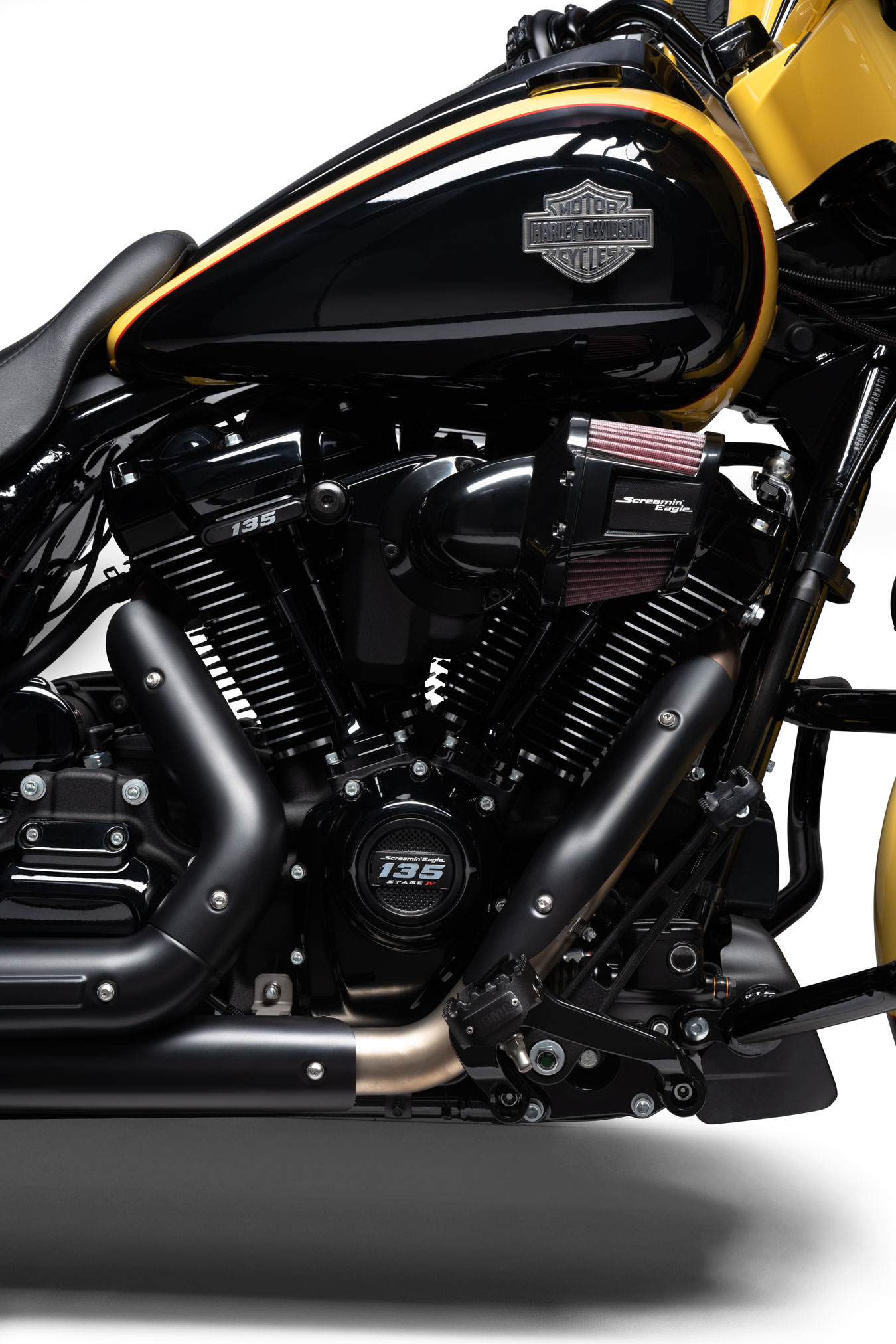
Since you read all about engines (you did right?) in our last chapter, you have some understanding of their pro’s and con’s of their design. For example, a Single/V-Twin is made for torque, a In-line 4/6 is made for horsepower. But Why, When and How is this possible and where does it take place?
Every engine I know of both the torque and the horsepower curves (not matter how funny they are) will meet at roughly 5,252 rpm and be equal. The formula is a constant. What’s important here is that HP is related to torque and speed of the engine. (hp=torque*RPM/5252, if RPM=5252 then RPM/5252=1 so hp=torque).
Now you must be wondering why we use HP to rate engines? What’s the point if the rate of change in speed is defined by torque? Hp is a measure of how well the engine can produce torque at high rpm. Lots of HP can mean two things: 1st: The engine can rev very fast, and 2nd: The engine makes a lot of torque at high rpm. To explain why HP can be good even if it’s nothing in itself, we’ll use the example of a Honda CB750 racing against a Yamaha V-Star 1100:
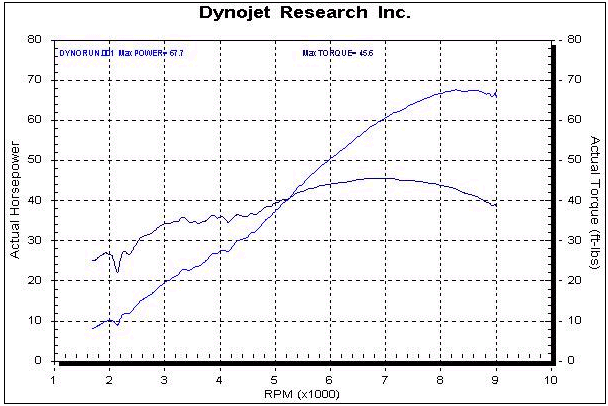
Honda CB750 (67.7 HP @ 8350 RPM and 45.6 ft/Lbs @ 6800 RPM of torque) versus a Yamaha V-Star 1100 (53.5hp@5900 and 57.8lbs@2500 of torque). The reason for the Honda CB750 to produce more HP is that the torque curve is tilted more towards high-rpm and the redline is higher. When driving smoothly around town, the Yamaha V-Star 1100 will feel more powerful than the Honda CB750 because it is producing more torque at low-rpm, the Honda CB750 will have to rev it’s engine a lot more than the Yamaha V-Star 1100 to keep the pace. On the other hand, if the two meets at the drag strip, the Honda CB750 will give a hard time to the V-Star. The Yamaha V-Star 1100 may have a much better launch due to it’s good torque at low-RPM, however, as the revs rise, the CB750 will start gaining speed faster because it will be in its powerband, while the Yamaha V-Star 1100 will start to gain speed slower. Then the 5900RPM mark will arrive on the Yamaha V-Star 1100 and the rider will have to shift into second gear.
But the best thing would be the perfect compromise between the both. For example, the higher redline and more powerful nature of the Inline-4 engine won’t necessarily mean that it will win: the most important part of a very short race is the launch and because of it’s torque, the Yamaha V-Star 1100 will launch faster than the Honda CB750, and will cover more distance in the same time. When the Honda CB750 gets in it’s powerband, it will be behind the Yamaha V-Star 1100 and will have to work harder to get ahead and surpass it on a longer stretch. On a very short race, (e.g. Stop light GP) the V-Star will win, but on long distances, the Honda CB750 will have the advantage.
For everyday people, torque is more important than HP because riders usually stay below 5500RPM, that’s why most motorcycle manufacturers (like Yamaha) tune their motorcycles to get more torque at low-rpm at the expense of some high-end power. And the fun part for them is that it’s usually cheaper to make an engine with good low-end torque.
Yamaha V-Star 1100: 14.50-sec. @ 90.3 mph best quarter-mile acceleration.
Honda CB750: 12.74 sec. @ 103.14 mph best quarter-mile acceleration.
Dyno Charts
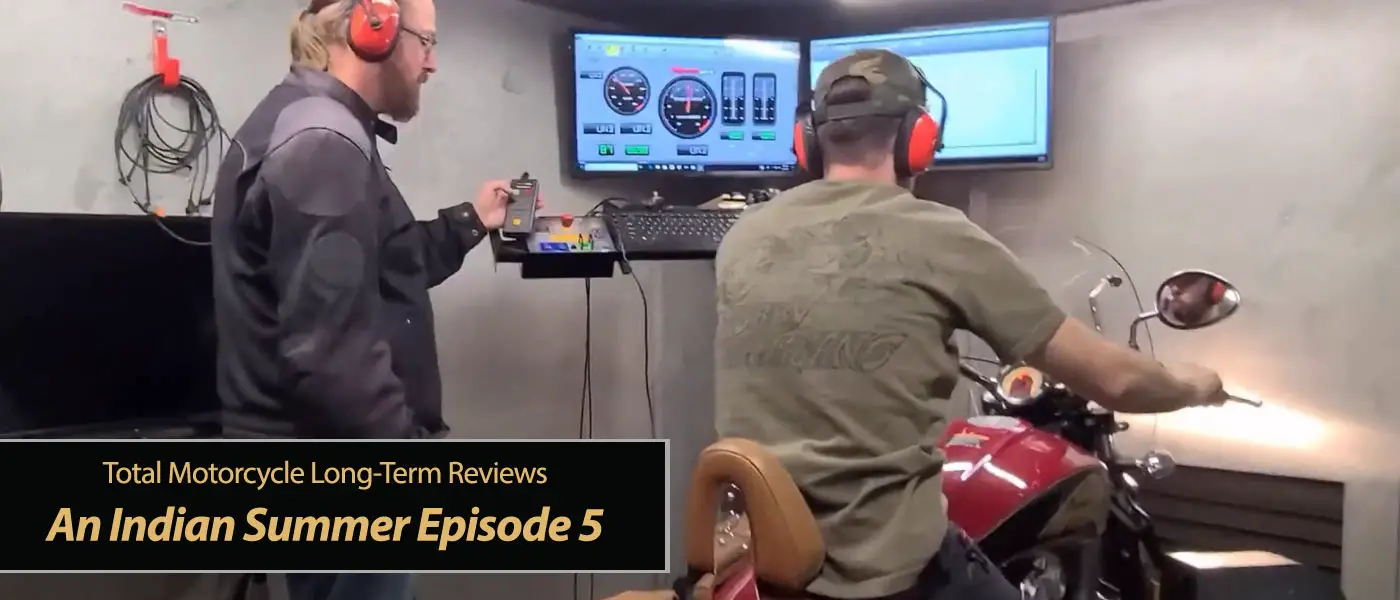
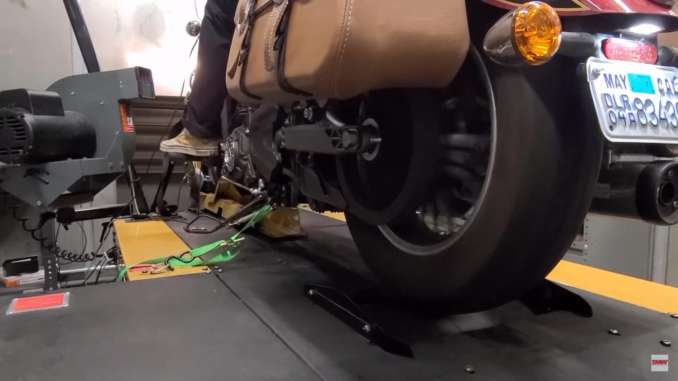
A dynamometer (or dyno for short) is a machine designed to measure horsepower and torque from a vehicle under load. They give you a line graphic showing you the results.
The dyno charts are a great way to understand why engines “feel” like they do and you can actually “see” the difference in that “feeling” using the charts.
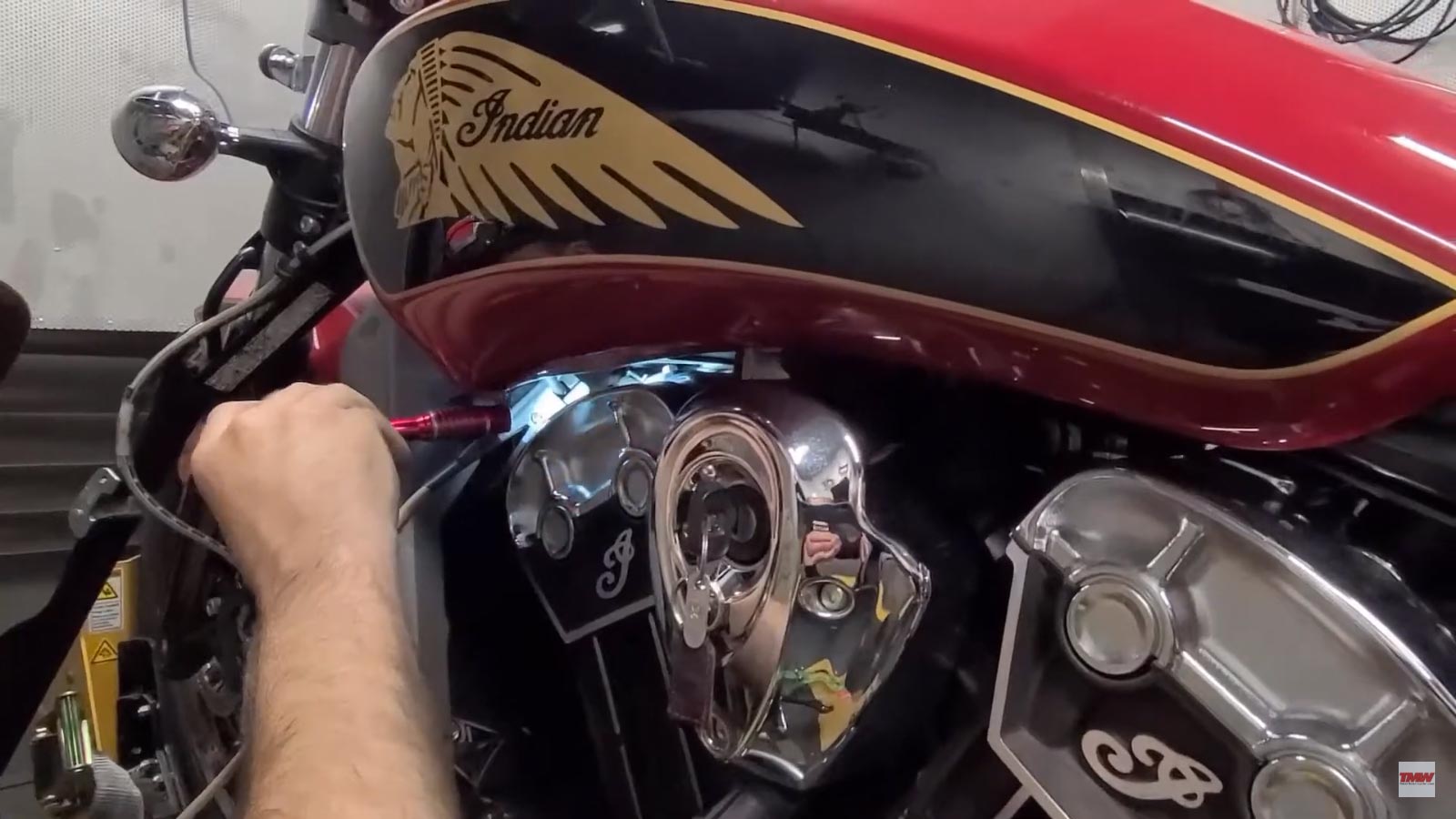
An Indian Summer Ep5: Scout Horsepower Dyno Runs!
Machine Learning – A Dyno Does What?
Getting a bike tested on a dynamometer – or dyno in the popular vernacular – is a great way to visualize it’s power output. We all know the common terms you can use to describe power deliver, right? Torque wave. Twitchy. Freight train. Fizzles. These are all ways to describe how a bike feels under you while you’re exercising your right wrist. But they’re subjective terms, imprecise at best and cliche at worst. They only mean something if you trust the reviewer.
Putting a motorcycle on a dyno, though, is the opposite of subjective. A dynamometer is a precise, calibrated machine that measures power output. The drive wheel rests atop a spinning drum, which measures the amount of force applied to it. An inductive pickup feeds engine rpm to the machine as well, so horsepower can be indexed to engine speed. Some machines also read exhaust gas chemistry so they can measure fueling throughout the rev range. That is, how the air fuel mixture is adjusted by the EFI on the fly.
Horsepower In, Horsepower Out
Manufacturers supply horsepower and torque numbers for their machines though, don’t they? They do, but typically those measurements are taken “at the crank”. This means they’re measuring the power put out directly by the engine. It’s a valid number, sure, but it doesn’t include the power losses through the rest of the drive train. Transmission, final drive, axle. To get a good measurement of how much power your bike delivers to the pavement, you have to take your reading at the wheel itself. That’s real world. That’s down to the ground.
For our 2019 Indian Scout, published horsepower and torque numbers are as follows:
Horsepower: 100hp @ 8,100 rpm
Torque: 72 ft-lbs @ 6,000 rpm
Click to Enlarge the Charts
Inline-4 Dyno Honda CB750
You can easily see that the Inline-4 produces the strongest torque in the middle RPM range for the engine, but drops sharply at either end. This type of torque is best suited for middle to upper RPM ranges and these bikes are best suited for that type of riding.
Inline-4 Engines: Dyno Honda CB750 Horsepower
You can see by the Inline-4 horsepower chart that the engine will just keep gaining more and more speed until very near it’s red line. As with the Inline-4 torque chart, this type of horsepower is best suited for middle to upper RPM ranges and these bikes are best suited for that type of riding.
It is easy to see why the Inline-4 engine is best suited to bikes designed to go fast and use high Rpm’s. These motorcycles will generally be the fastest types on the road in their engine sizes.

Single Cylinder Engines: Dyno Honda XR650L BMW F650GS
The single cylinder engine produces both its torque and horsepower in the low to middle RPM range only and this is good for slower speed riding situations.
Many dirtbikes, dual sports, enduro and motocross motorcycles use this type of engine since top speed is not as important and pushing through terrain at low speeds.

V-Twin Engine: Dyno-Yamaha V-Star 1100 Silverado 1063cc
The V-Twin engine is designed to produce lots of torque a very low RPMs. While horsepower is good in the middle range. While this type of engine may not be as fast as an Inline-4, you will actually feel like you would get there faster.
Very suitable for normal everyday riding where speeds are set by legal limits and acceleration is appreciated to get to the legal limits. While many cruisers use this type of engine, some sport bikes are using it as well but because of the HP and torque curves, these types of bikes will generally not be as fast as the Inline-4’s.

Harley-Davidson V-Twin Engine: Dyno – Harley XL1200S
Like the Yamaha, the Harley has the same characteristics and will give the same type of acceleration “feeling” regardless of the way it sounds.
While sound is also very characteristic, it does nothing for how HP and Torque curves are.
Conclusion
So there you have it. Not only do you understand engines, but also the design, horsepower, torque, sound, and reasons behind putting that type of engine in a bike. You can easily see that there is no “perfect” do-it-all engine, only compromises since every design does something better than another design.
Yes, you could put an Inline-4 into a Cruiser, or a V-Twin/Single into a sports bike, but they will have a completely different character than if switched around. Maybe that is what you want? Or that is what appeals to you. If so, speak with your pocketbook at your local motorcycle dealer. Yes, the manufacturers will hear your voice with every bike like that sold.